


Launching a working campaign and scaling a working campaign are not the same job. At low spend, instagram advertising can survive on a narrow pocket of efficient demand, one strong creative angle, and a decent landing page. Once you push harder, the account starts revealing whether the system underneath is actually robust or whether it was only holding together because the spend was too small to expose the weak points.
This is where many advertisers misread performance. They think scaling broke the campaign, when in reality scaling exposed the campaign. The audience may have been too small, the creative may have had no second act, the offer may only have appealed to the easiest buyers, or the tracking may have been too messy to guide optimization once spend increased.
Vertical Scaling Is Faster, But It Is Also Fragile
The simplest way to scale is to raise budget on what already works. That is attractive because it is operationally easy, but it can destabilize delivery if the campaign was only barely efficient to begin with. Meta’s own delivery best practices make the broader point clearly: stability helps the system work better, and unnecessary disruption makes learning harder.
The practical takeaway is that not every winning ad set deserves aggressive budget increases. Some deserve protection instead. If a campaign is relying on one audience pocket and one creative angle, forcing more spend into it can push delivery into weaker impressions faster than the economics can handle.
Horizontal Scaling Usually Lasts Longer
Horizontal scaling is less exciting, but it is often healthier. Instead of only increasing budget, you expand by introducing new creatives, adjacent audience inputs, additional offer angles, or new post-click paths that keep the system from leaning too hard on a single winner. That gives the account more room to grow without asking one ad to carry the entire business.
This is also where creative diversification starts paying off. Meta’s guidance on creative diversification exists for a reason: accounts become more resilient when they are built on multiple persuasive angles instead of one overworked asset. In real terms, that means you should be scaling a portfolio of messages, not a single ad that happened to spike.
Automation Helps, But It Does Not Remove Strategy
A lot of the newer Instagram ad workflow pushes advertisers toward automation. In many cases that is the right direction. Meta continues to expand the Advantage+ campaign experience, Advantage+ placements, and Advantage+ sales campaigns, all of which are designed to reduce manual setup and let the system optimize in real time.
That does not mean strategy has become irrelevant. It means bad strategy gets exposed faster. Automation can distribute budget efficiently, but it cannot fix a weak offer, a confused funnel, poor follow-up, or creative that never deserved scale in the first place.
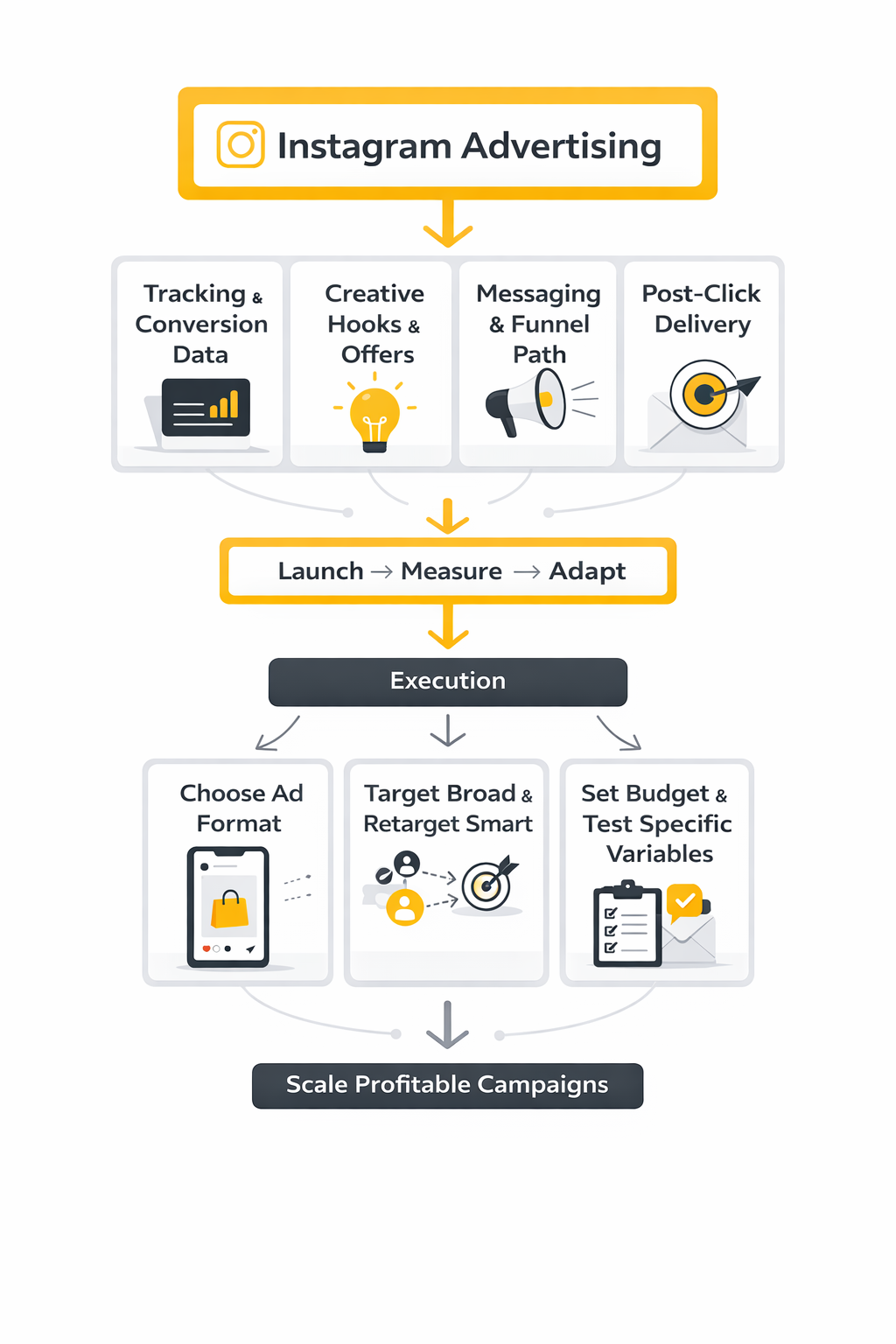
Let The Machine Handle Delivery, But Not Positioning
The strongest use of automation is usually in delivery, placement distribution, and real-time matching. That is where the platform has more data than any human buyer can manage manually. Trying to out-click the system on every mechanical decision is usually wasted effort.
Where human judgment still matters most is positioning. You still have to decide what promise to lead with, what objection to neutralize, what proof to feature, and what segment deserves a different story. Meta can automate distribution, but it cannot invent strategic clarity for you.
Automation Becomes Dangerous When Your Inputs Are Weak
This is the part people skip. Automation gets better when the account has clean tracking, enough conversion volume, and distinct creative inputs. It gets worse when the signal is noisy and the assets are generic.
That is why broad automated campaigns often work brilliantly for disciplined operators and terribly for messy ones. The system is not “wrong” in either case. It is simply amplifying the quality of the inputs it was given.
Attribution Gets Harder As The Account Improves
One of the strange things about better instagram advertising is that it often becomes harder to measure neatly. As your brand gets stronger, more people see your ads, remember your name, come back later, convert on another device, or buy through a separate touchpoint that never shows up cleanly in platform reporting. The account improves, but the neatness of the story gets worse.
Meta’s documentation on attribution models and settings makes it clear that reported results depend on the attribution setup you use. It also explains in its multiple attribution settings guidance that comparing results across windows can create interpretation issues if you do not understand what is being counted. That matters because many scaling decisions get made from reports that look precise but are only one partial view of reality.
Platform Attribution Is Useful, But It Is Not The Whole Truth
You should absolutely use in-platform reporting to optimize campaigns. It is still one of the fastest ways to see which creatives, placements, and ad sets are driving response. But it is not wise to treat the Ads Manager number as the only number that matters once spend becomes meaningful.
This is why more advanced operators compare platform data with CRM outcomes, blended revenue, lead quality, close rates, and customer value. If Meta says performance is steady but sales quality is dropping, the account is not actually steady. If platform ROAS softens while total revenue and new customer growth rise, the account may be healthier than the dashboard suggests.
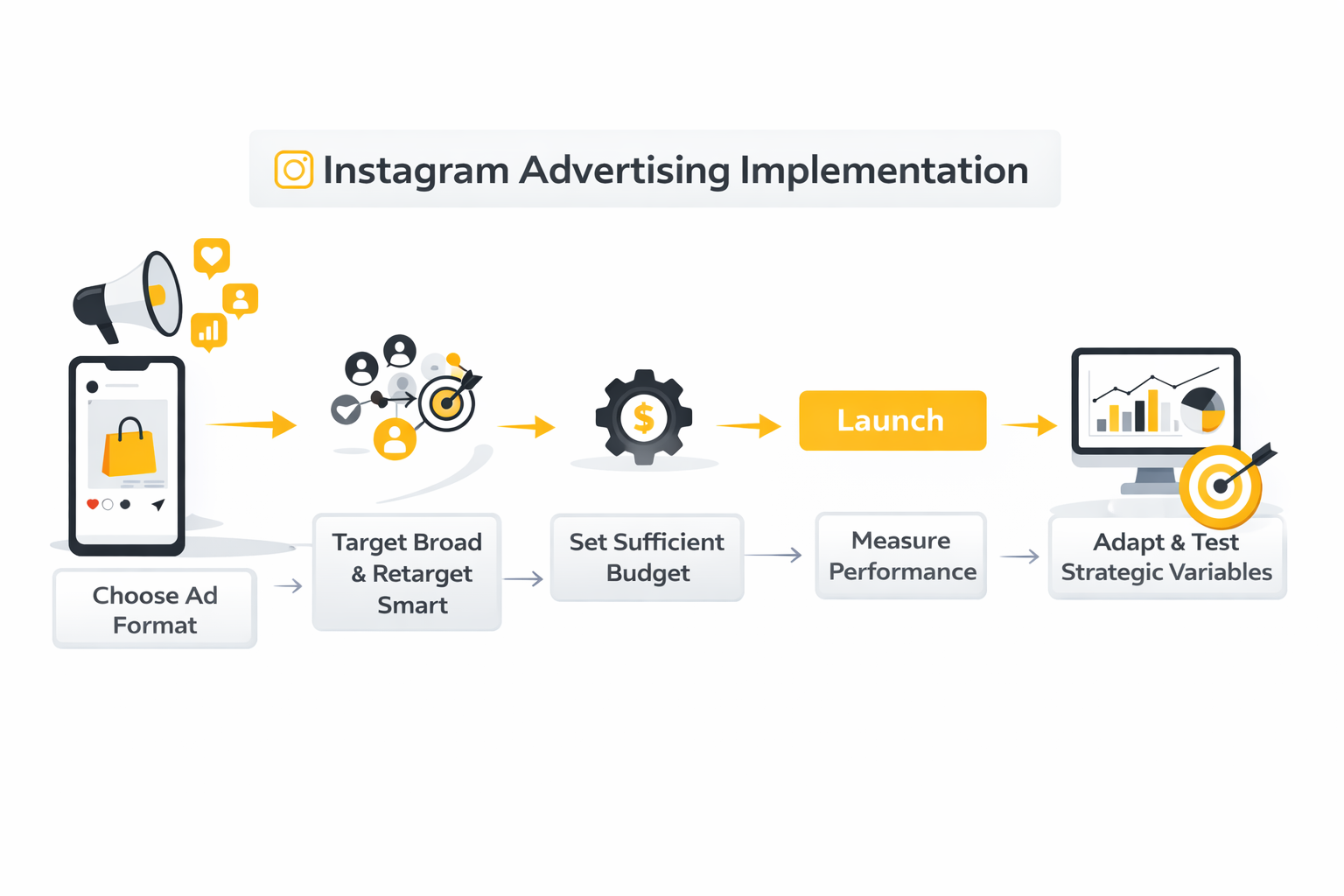
Incrementality Matters More Than Last-Click Comfort
Meta has been pushing more directly into incrementality, including incremental attribution reporting and public guidance on calibrating attribution with incrementality experiments. That shift matters because last-click thinking routinely overvalues bottom-funnel capture and undervalues the ads that created demand earlier.
For advanced advertisers, this changes how scaling decisions should be made. The question is not only whether an ad was present before a conversion. The better question is whether the conversion was more likely because the ad ran. That is a harder question, but it is closer to the truth that actually matters.
Signal Loss Has Changed The Rules
Privacy changes and data restrictions are not a side note anymore. They are part of the operating environment. IAB’s State of Data 2025 and its 2025 companion guide both point to the same reality: signal deprecation has pushed the industry harder toward first-party data, privacy-safe measurement, and more model-based decision-making.
For instagram advertising, that means two things. First, your own data is more important than it used to be. Second, clean experimentation and disciplined funnel tracking matter more because you will not always get a perfect user-level picture of what happened.
First-Party Data Is No Longer Optional
If you are still treating customer lists, qualified lead tags, repeat purchase segments, and email engagement data as side projects, you are behind. These inputs help platforms learn better, help retargeting stay useful, and help your business keep functioning when reporting gets noisier.
This is one reason integrated follow-up and CRM systems matter more as you grow. A stack built around tools like GoHighLevel, Copper, or a clean form and scheduling flow through Fillout and Cal.com can make the difference between vague lead reporting and a usable revenue feedback loop. Better first-party structure does not just help attribution. It improves operations.
Modeled Measurement Requires More Patience
When signal quality drops, advertisers often react by chasing faster and noisier metrics. That is usually the wrong response. In a lower-signal environment, short-term volatility becomes less trustworthy, which means you need cleaner tests, clearer definitions of success, and more discipline about when not to touch a campaign.
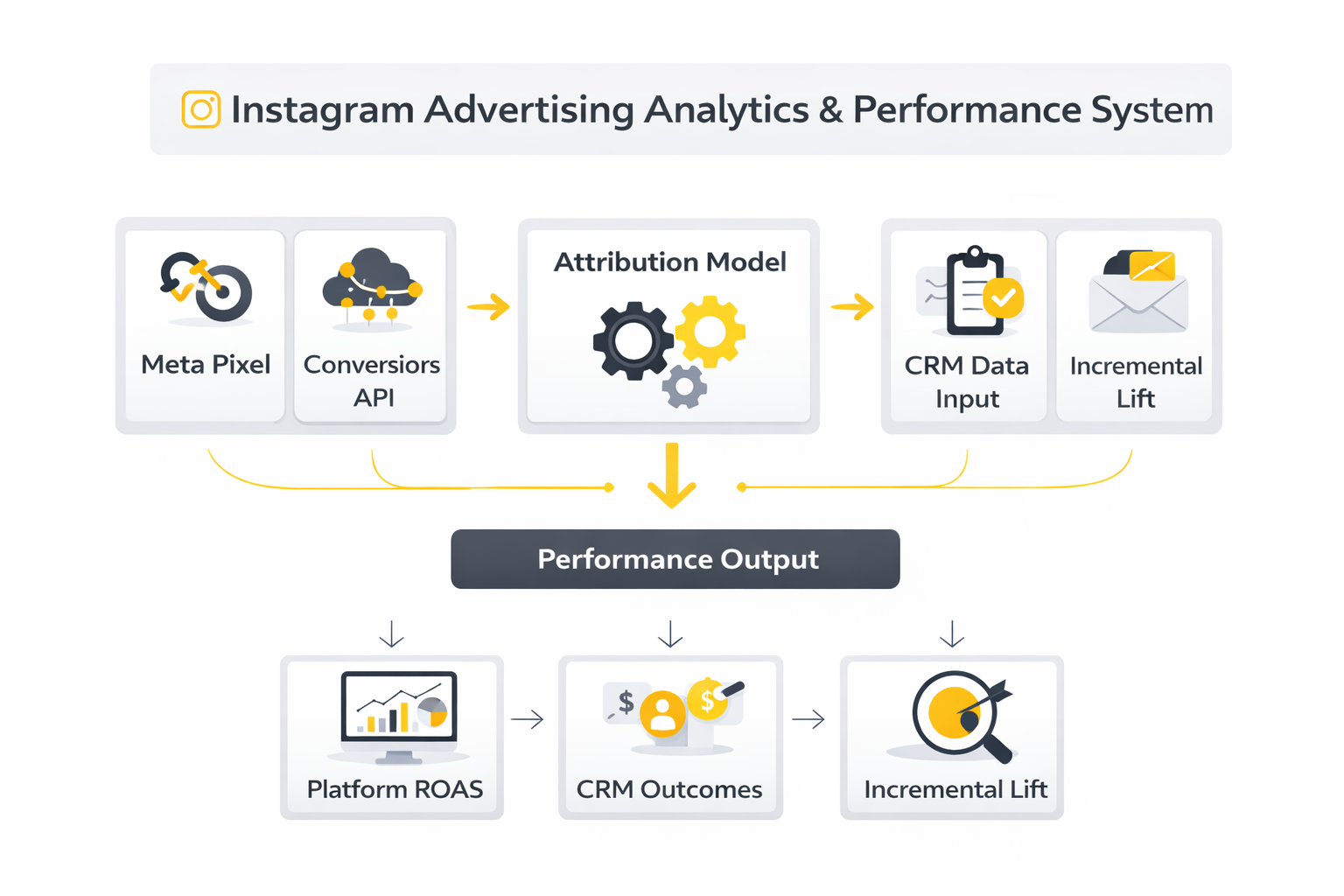
This is where mature operators pull ahead. They do not pretend the data is perfect. They build a measurement system that can still support solid decisions even when the platform view is incomplete.
Creative Fatigue Is Usually A Systems Problem
Creative fatigue does not just happen because people are bored. It happens because the account was built with no creative renewal system. Meta’s creative fatigue recommendations and its work on creative optimization with AppsFlyer and Dentsu Creative make the same broader point: performance depends on ongoing creative variation, not one lucky asset.
That matters even more on Instagram because format expectations move quickly. What felt native three months ago can feel stale now. If your ad account depends on one format, one spokesperson, or one script pattern, it is not built for sustained growth.
Refresh Angles Before Performance Fully Cracks
The worst time to think about new creative is after the account is already slipping. By that point, delivery often gets more expensive, frequency has climbed, and the team is rushing. A stronger approach is to build replacement angles while the current winner is still healthy.
This also changes how you judge “winning ads.” The real winner is not the ad that survives forever. It is the ad that teaches you what message the market wants so you can create the next round faster and with more confidence.
Similar Ads Can Cannibalize Each Other
Another advanced issue is similarity. If you keep launching tiny variations of the same concept, you may think you are testing broadly when you are really forcing multiple ads to compete for the same response pattern. That can make reporting look more scientific than it actually is.
The fix is not more assets for the sake of volume. The fix is genuine diversity in concept, structure, proof, and offer framing. Creative breadth matters more than creative quantity.
Compliance Risk Is A Real Business Risk
A lot of advertisers think policy is an annoyance until an ad gets rejected or an account gets restricted. That mindset is expensive. Meta’s Advertising Standards, policy basics checklist, and guidance on personal attributes violations make it very clear that certain claims, framing choices, and targeting behavior can trigger review problems.
This matters more as spend grows because operational risk grows with it. A small account can survive the occasional rejection. A scaled account depending on continuous lead flow can get hit much harder if approvals slow down, assets are disabled, or restrictions spill into the wider business process.
The Most Common Problem Is Usually How The Ad Is Framed
Many policy problems do not come from illegal products or obvious scams. They come from casual phrasing that implies personal traits, health conditions, financial hardship, or sensitive identity details about the viewer. That is especially relevant for coaching, wellness, finance, and appearance-related offers, where marketers often write copy that sounds punchy but crosses a line.
The smartest move is to build compliance into the creative process, not treat it as final-stage cleanup. Strong ads can still be direct and persuasive without leaning on risky phrasing that invites unnecessary review trouble.
Restricted Or Deceptive Practices Can Kill Momentum Fast
Meta also maintains guidance on advertising restrictions and unacceptable business practices. If your funnel creates confusion, overpromises, hides the true terms, or uses misleading before-and-after logic, you are not just risking lower trust. You are risking operational interruption.
At scale, trust and compliance start merging into the same issue. The cleaner the offer and the clearer the page, the easier it is to maintain approval, conversion quality, and long-term efficiency at the same time.
The Real Expert Move Is To Scale The Entire System
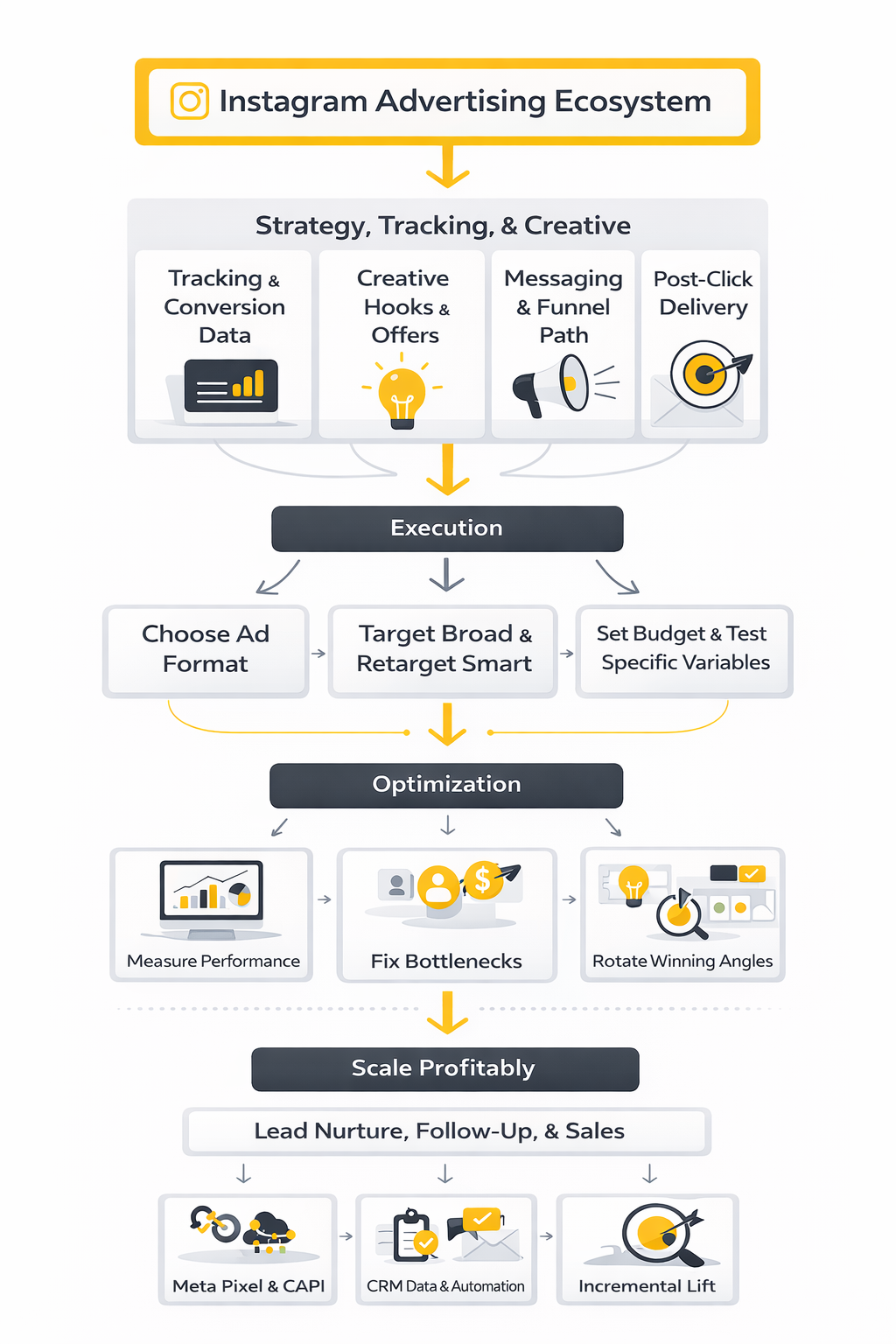
The beginner view of instagram advertising is ad-centric. The advanced view is system-centric. The ad matters, but so do the landing page, the form logic, the CRM, the nurture flow, the appointment booking, the sales process, the retention engine, and the quality of the data feeding back into the platform.
That is why the best gains at the advanced level often come from fixing bottlenecks outside Ads Manager. Better creative helps. Better follow-up often helps more. Better offer positioning can matter even more than both. Once you see the system clearly, you stop asking whether Instagram ads work and start asking whether your business is structured well enough to capitalize on the demand they create.
The close of this article should be simple. Instagram advertising rewards clarity, speed, adaptability, and operational discipline. The platform keeps changing, but that core truth has not changed at all.