

Most businesses don’t fail because they lack marketing. They fail because their growth is fragmented.
One team runs ads. Another builds funnels. Someone else handles retention. Nothing connects. And when nothing connects, growth becomes unpredictable, expensive, and impossible to scale.
That’s exactly why the concept of a growth agency has exploded over the past few years. Instead of focusing on isolated tactics, these agencies build unified systems designed to drive consistent, measurable business growth across the entire customer journey.
The timing isn’t random. The global marketing agency market is already worth over $473 billion, and it’s evolving fast toward performance-driven, data-led models.
A growth agency sits right at the center of that shift.
Article Outline
- What a growth agency actually is
- Why growth agencies matter more than ever
- How the growth agency model works
- The core components of a growth agency
- How professionals implement growth systems
- What separates elite growth agencies from average ones
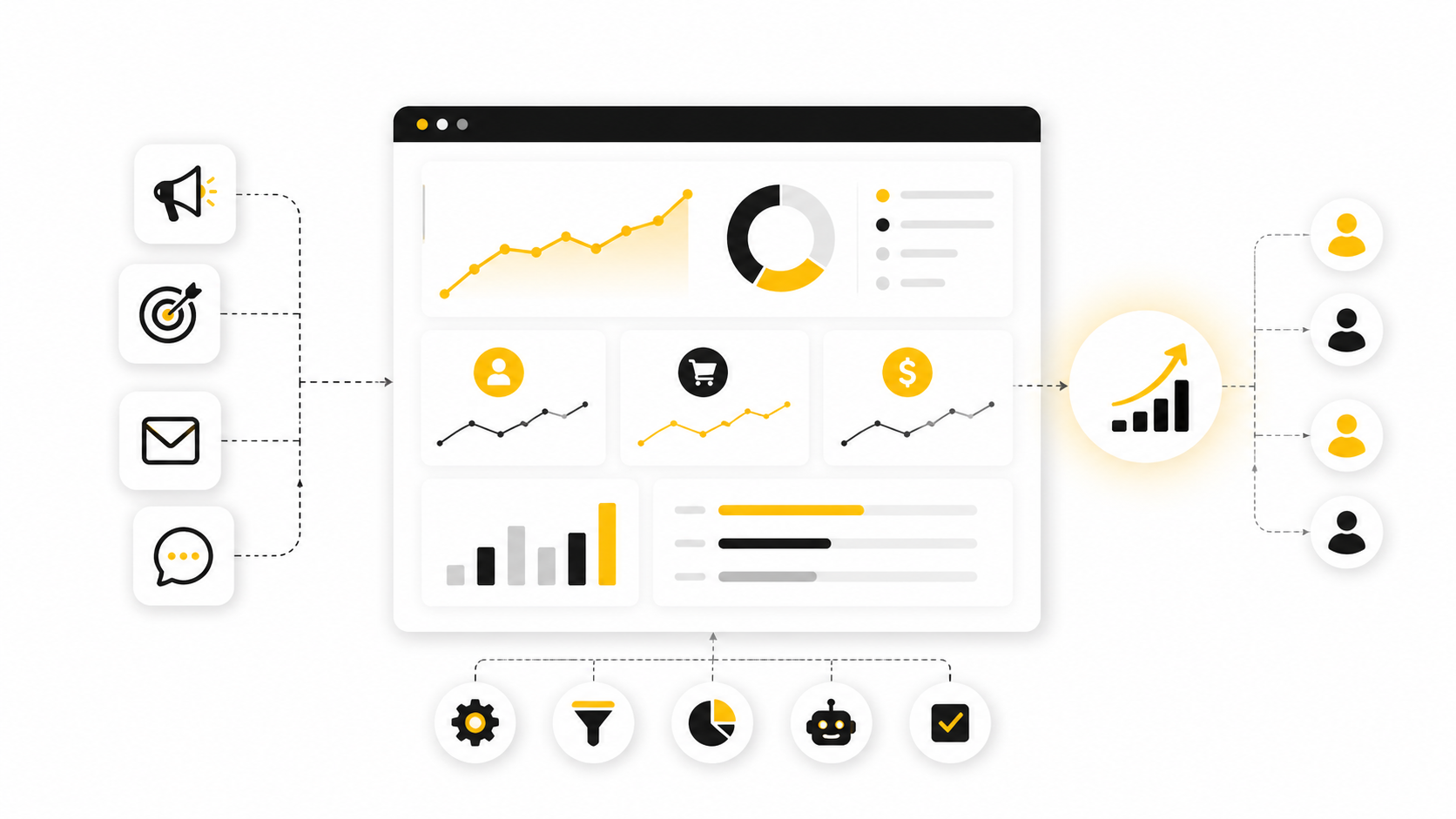
What a Growth Agency Actually Is
A growth agency is not just another marketing provider. It’s a strategic partner built around one goal: scalable, measurable business growth.
Unlike traditional agencies that focus on single channels like SEO or paid ads, a growth agency looks at the entire system. That includes acquisition, conversion, retention, and monetization. Every touchpoint matters because every touchpoint affects revenue.
At its core, a growth agency blends marketing, product thinking, and data analysis into one operating model. Instead of asking, “How do we get more traffic?”, it asks, “How do we grow the business efficiently across the full lifecycle?”
That difference is everything.
A growth agency typically:
- Runs continuous experiments across funnels and channels
- Tracks performance down to revenue impact
- Optimizes the full customer journey, not just top-of-funnel
- Aligns marketing with sales and product
This is why many describe it as a hybrid between a marketing team, a data lab, and a revenue engine.
Why Growth Agencies Matter More Than Ever
The old marketing model is breaking.
Businesses used to rely on brand awareness, long campaigns, and slow feedback loops. That doesn’t work anymore. Today, growth needs to be fast, data-driven, and adaptable in real time.
The pressure is coming from everywhere:
- Customer acquisition costs are rising
- Privacy changes are reducing tracking visibility
- Competition is increasing across every channel
- Internal teams struggle to keep up with complexity
At the same time, expectations are higher. Founders and operators don’t want vague reports or vanity metrics. They want predictable revenue growth.
This is where growth agencies step in.
They replace disconnected tactics with integrated systems. Instead of guessing what works, they test everything. Instead of reporting impressions, they measure revenue.
The shift is already visible across the industry. Around 74% of agencies reported revenue growth recently, with nearly half growing by 25% or more.
That growth isn’t coming from traditional services. It’s coming from agencies that understand systems, data, and scalability.
How the Growth Agency Model Works
A growth agency operates like a continuous optimization machine.
Instead of launching campaigns and waiting for results, it runs ongoing experiments across the entire funnel. Every campaign, landing page, and email sequence becomes part of a system that improves over time.
Here’s the key idea: growth is not a campaign — it’s a process.
That process usually looks like this:
- Analyze the current funnel and identify bottlenecks
- Prioritize high-impact growth opportunities
- Launch experiments across channels and touchpoints
- Measure results in real time
- Scale what works and eliminate what doesn’t
This cycle repeats constantly. The goal is simple: compound small wins into massive growth over time.
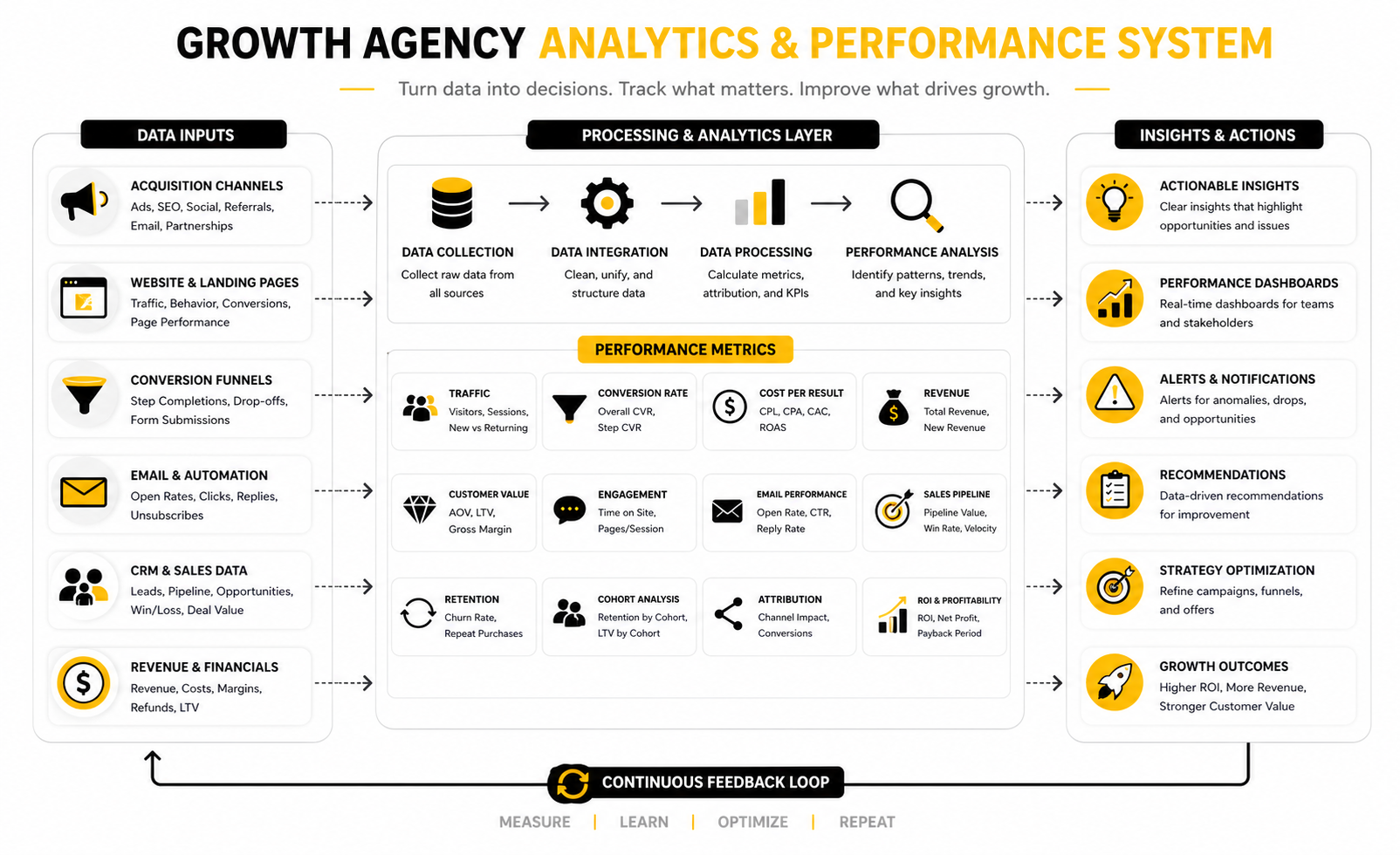
To make this work, growth agencies rely heavily on tools and automation.
For example, platforms like GoHighLevel are often used to centralize CRM, funnels, automation, and communication into one system. Instead of juggling multiple disconnected tools, everything runs inside a unified growth stack.
That’s not just convenience. It’s leverage.
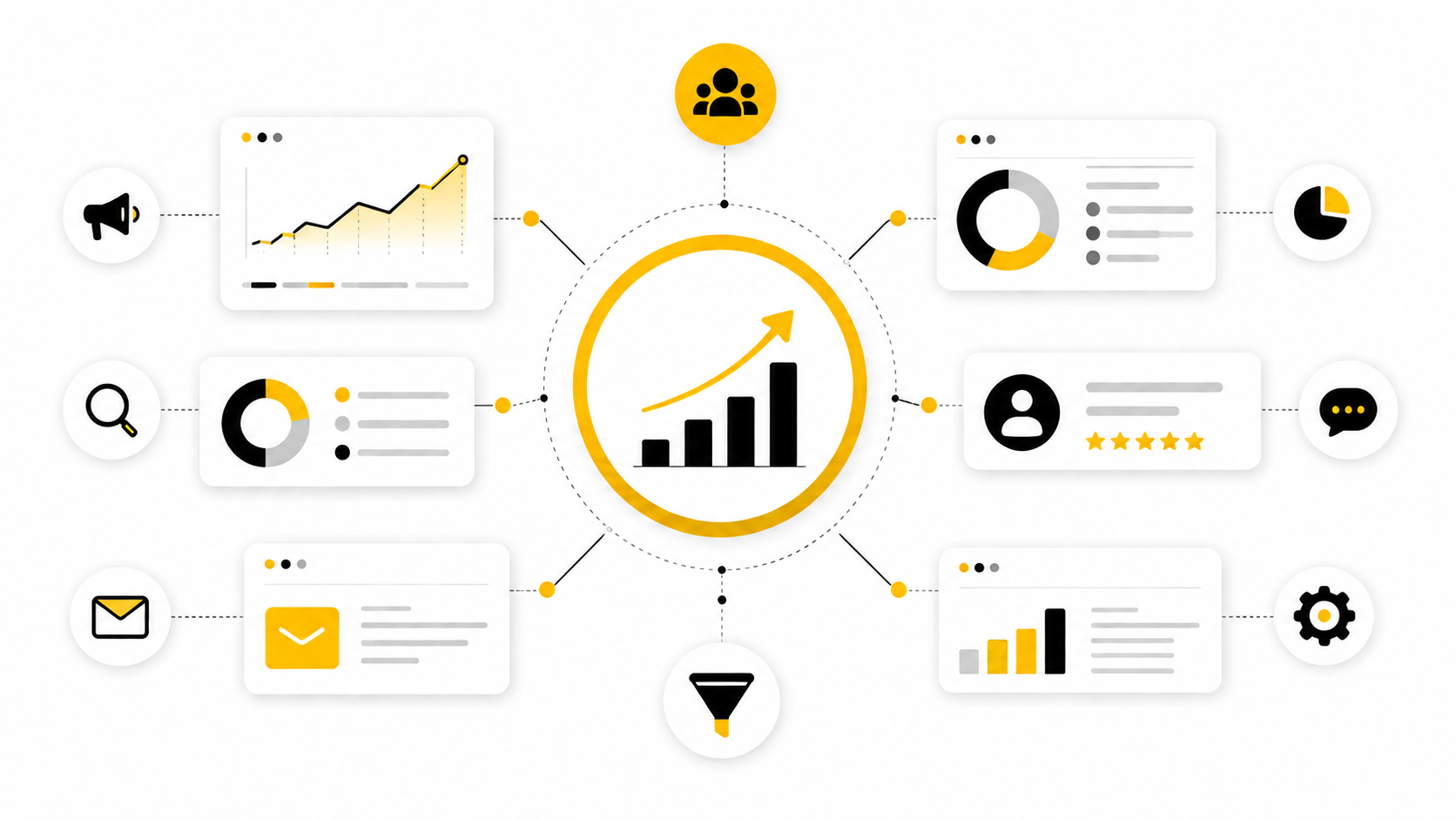
Framework Overview: The Growth System Behind Every Agency
Every effective growth agency follows a structured framework, even if they don’t explicitly call it one.
At a high level, the framework connects four critical stages:
- Traffic (getting attention)
- Conversion (turning visitors into leads or customers)
- Retention (keeping customers engaged)
- Monetization (increasing lifetime value)
Most businesses focus heavily on the first stage. Growth agencies optimize all four simultaneously.
This is where tools like ClickFunnels or Systeme.io come into play. They allow agencies to build, test, and refine funnel structures quickly without relying on slow development cycles.
But tools alone don’t create growth.
The real advantage comes from how everything is connected:
- Data flows across all stages
- Decisions are based on performance, not opinions
- Experiments are prioritized by impact
This framework turns growth from something unpredictable into something engineered.
And once it’s engineered, it can scale.
The Core Components of a Growth Agency
A strong growth agency is built around connected capabilities, not random services.
That matters because growth breaks when the pieces do not talk to each other. Paid ads might drive traffic, but weak landing pages waste the traffic. A sales team might close deals, but poor follow-up leaks revenue. Email might convert well, but only if the audience is segmented properly.
The best agencies understand this chain. They do not treat marketing as a menu of services. They treat it as a system where each part either compounds the next part or quietly kills momentum.
Growth Strategy
Strategy is the starting point because it decides where effort should go first.
A growth agency should not begin by launching ads, rebuilding a website, or writing content just because those things feel productive. It should begin by finding the biggest constraint in the business. Sometimes that constraint is traffic. Sometimes it is conversion. Sometimes it is pricing, onboarding, retention, offer clarity, or sales speed.
This is where average agencies and serious growth partners separate fast. Average agencies sell deliverables. A real growth agency diagnoses the business model, maps the funnel, and identifies the highest-leverage moves before touching execution.
Customer Acquisition
Customer acquisition is where most companies expect a growth agency to focus first.
That makes sense, but acquisition is not just “getting more leads.” It includes paid media, organic search, partnerships, outbound systems, creator campaigns, referral loops, and content distribution. The right channel depends on the market, offer, margin, sales cycle, and customer behavior.
This is also where the market is getting tougher. Agency leaders are leaning harder into paid channels, with 68% expecting paid advertising to deliver the strongest results in 2025. That does not mean paid ads are always the answer. It means growth teams need sharper testing, stronger creative, and better tracking because lazy traffic is getting expensive.
Conversion Systems
Traffic without conversion is just noise.
A growth agency has to understand how to turn attention into action. That includes landing pages, lead magnets, checkout flows, demo booking pages, webinar funnels, sales pages, and post-click messaging. Every step should reduce friction and make the next action obvious.
For funnel-heavy businesses, tools like ClickFunnels can help teams launch and test pages quickly. For leaner operators who want funnels, email, and simple automation in one place, Systeme.io can also fit naturally. The tool is not the strategy, but the right tool makes iteration faster.
Lifecycle Marketing
Growth does not stop when someone becomes a lead or customer.
This is where lifecycle marketing becomes a serious advantage. A growth agency should know how to nurture leads, activate new customers, increase repeat purchases, reduce churn, and create expansion opportunities. These moves often produce better returns than constantly chasing colder traffic.
Email, SMS, CRM automation, retargeting, and customer segmentation all matter here. Platforms like Brevo, Moosend, and ManyChat can support this part of the system when used with a clear journey, not just random broadcasts.
Data and Experimentation
A growth agency lives or dies by the quality of its feedback loops.
If the team cannot measure what is working, it cannot improve the system with confidence. That means tracking the right metrics, building clean dashboards, reviewing experiments regularly, and connecting marketing activity to pipeline or revenue wherever possible. Vanity metrics are not enough.
This is especially important now because marketing budgets are tight. Gartner’s 2025 CMO Spend Survey found that marketing budgets have flatlined at 7.7% of company revenue, while 59% of CMOs still say they lack enough budget to execute their strategy. That reality rewards agencies that can prioritize, prove impact, and cut waste quickly.
Why the Best Growth Agencies Think in Systems
The biggest mistake businesses make is judging growth work channel by channel.
They ask whether ads are working, whether email is working, or whether SEO is working. Those are fair questions, but they are incomplete. A channel can look weak because the offer is unclear, the page is slow, the sales follow-up is poor, or the onboarding experience does not create enough value.
A growth agency should zoom out before zooming in. It should understand how the business attracts demand, captures demand, converts demand, and expands demand over time. That system view is what turns separate marketing activities into a real growth engine.
This is why integrated platforms can be useful when the agency needs one place to manage leads, automations, funnels, bookings, and client communication. GoHighLevel is popular in that context because it helps agencies centralize operations instead of stitching together too many disconnected tools. Used well, that makes the growth system easier to manage, measure, and improve.
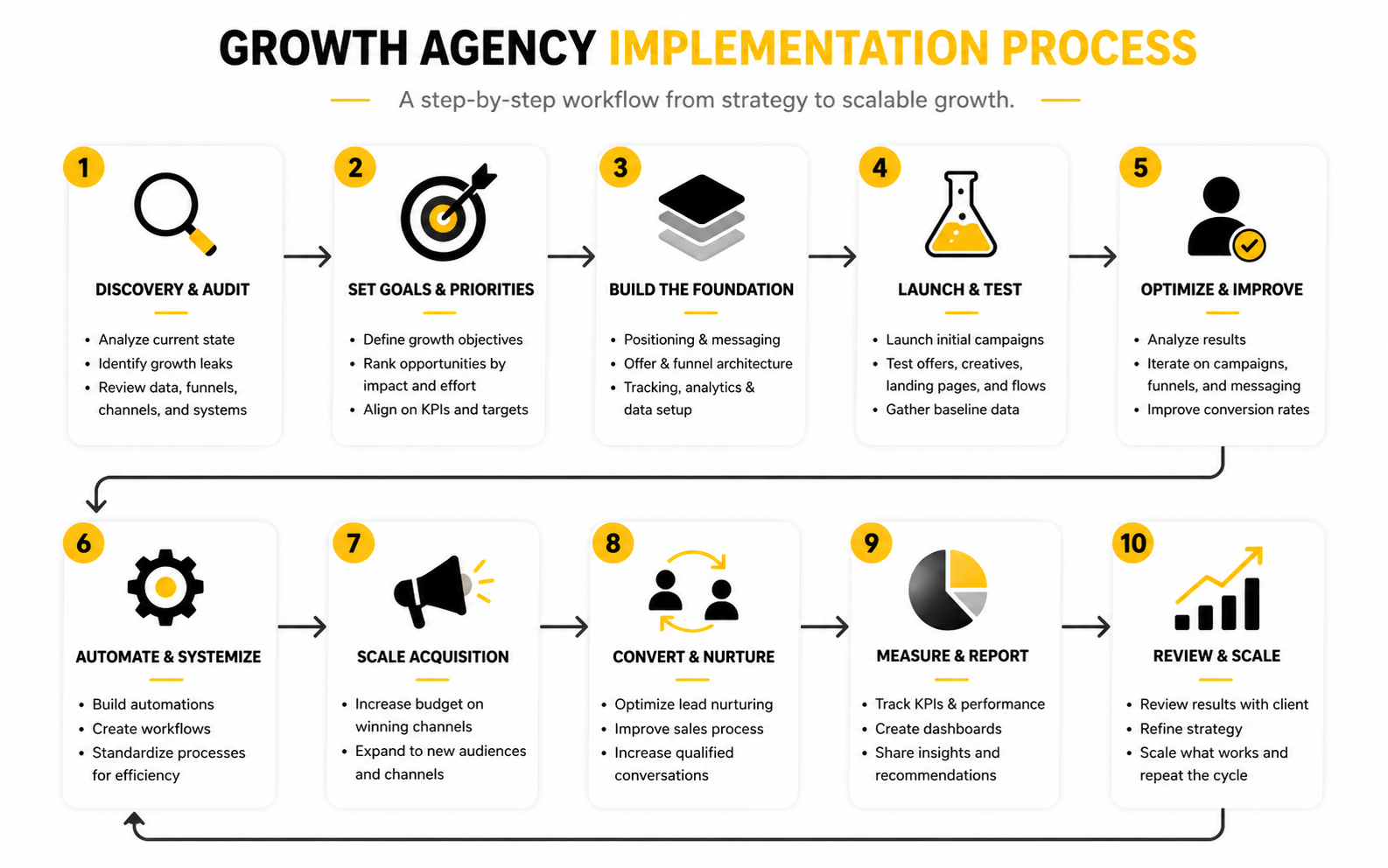
How Professionals Implement Growth Systems
Implementation is where a growth agency proves whether it actually understands growth.
Strategy can sound impressive in a proposal, but execution exposes everything. If the agency cannot turn research into campaigns, campaigns into data, and data into better decisions, the growth system never becomes real. It stays stuck as a nice-looking plan.
Professional implementation starts with sequencing. The agency does not try to fix everything at once. It decides what has to happen first, what can wait, and which improvements will unlock the next stage of growth.
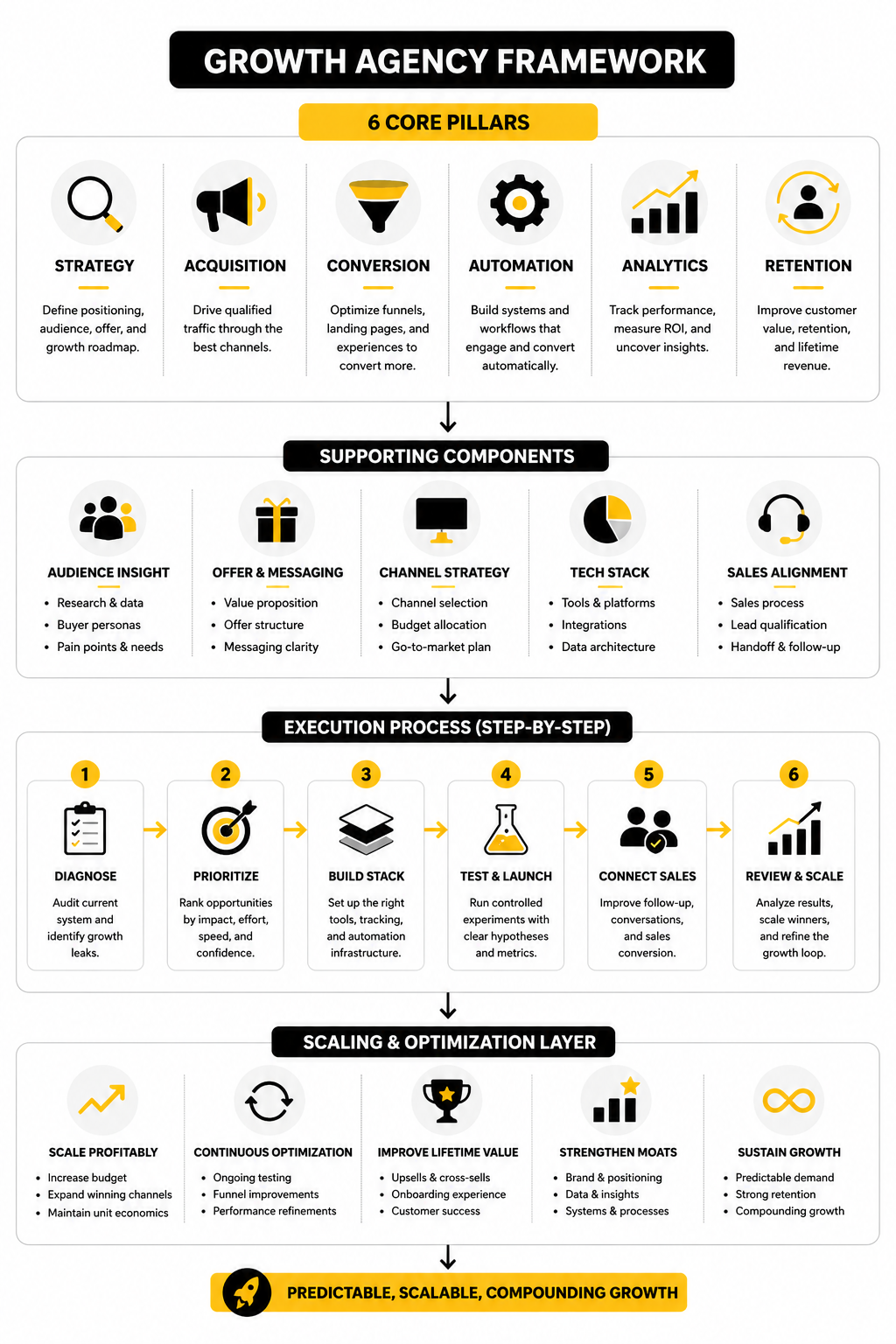
Step 1: Diagnose the Current Growth System
The first step is a proper audit.
A growth agency should review the offer, audience, traffic sources, conversion points, CRM setup, sales process, retention flows, and reporting stack. The point is not to collect information for the sake of it. The point is to find the leaks that are costing the business money.
This usually means looking beyond obvious marketing metrics. Low conversion rates may be caused by weak positioning. Poor lead quality may come from the wrong acquisition channel. Slow revenue growth may come from follow-up problems rather than traffic problems.
Step 2: Set the Growth Priorities
Once the audit is clear, priorities matter more than activity.
A serious growth agency ranks opportunities by expected impact, effort, speed, and confidence. This keeps the team focused on work that can actually move revenue instead of getting trapped in busywork. That discipline matters even more when budgets are tight, especially with marketing budgets holding flat at 7.7% of company revenue in 2025.
Good prioritization also creates better client alignment. Everyone knows why a landing page test comes before a new ad channel, or why CRM cleanup comes before scaling paid media. That removes guesswork and makes execution easier to defend.
Step 3: Build the Operating Stack
After priorities are clear, the agency needs the right operating stack.
This includes the tools used for funnel building, tracking, automation, scheduling, reporting, communication, and customer management. A messy stack slows down testing and creates bad data. A clean stack helps the team move faster without losing visibility.
For many service businesses and agencies, GoHighLevel can act as the central growth hub because it combines CRM, funnels, automations, calendars, messaging, and pipeline management. For ecommerce landing pages, Replo can be useful when speed and page experimentation matter. The right choice depends on the business model, but the principle stays the same: the stack should support growth, not complicate it.
Step 4: Launch Controlled Experiments
A growth agency should not gamble with big, unfocused campaigns.
It should run controlled experiments with clear hypotheses, clean measurement, and defined success criteria. That could mean testing a new landing page angle, a different lead magnet, a revised checkout flow, a segmented email sequence, or a new paid acquisition audience. Each test should teach the team something useful, even when it fails.
This is where modern marketing is moving fast. Paid advertising is now offered by 89% of surveyed agencies, and 68% expect it to deliver the strongest results in 2025. That level of competition makes weak testing expensive. You need stronger creative, sharper targeting, and faster feedback loops.
Step 5: Connect Sales and Follow-Up
Growth often breaks after the lead is captured.
A form submission means nothing if follow-up is slow, inconsistent, or irrelevant. A booked call means nothing if the sales process does not match the promise that created the booking. This is why a growth agency has to care about what happens after the conversion.
Automation can help, but only when it feels human. Tools like ManyChat can support fast conversational follow-up, while Cal.com can reduce scheduling friction. The goal is simple: make it easy for interested people to take the next step before momentum disappears.
Step 6: Review, Learn, and Scale
The final implementation step is review.
A growth agency should look at performance on a consistent rhythm and make decisions from the evidence. Winning experiments get scaled. Weak experiments get paused or reworked. Unclear results get investigated instead of ignored.
This is not glamorous, but it is where the compounding happens. Better reporting improves decisions. Better decisions improve experiments. Better experiments improve revenue. That loop is the real engine behind professional growth implementation.
Statistics and Data: What Growth Measurement Actually Means
Data is only useful when it changes what you do next.
A growth agency should not report numbers just to look sophisticated. The point of measurement is to make better decisions about where to invest, what to fix, what to scale, and what to stop. If a dashboard does not help the team make those decisions faster, it is probably noise.
This matters because growth work is getting more expensive and less forgiving. Marketing budgets are holding at 7.7% of company revenue, while teams are still expected to produce stronger outcomes. That puts pressure on every campaign, funnel, and channel to prove its role in revenue.
The Metrics That Actually Matter
A growth agency should measure the full path from attention to revenue.
That means looking at acquisition cost, conversion rate, lead quality, sales velocity, customer lifetime value, payback period, retention, and expansion revenue. These numbers work together. Looking at one of them in isolation can easily create the wrong decision.
For example, a channel with a cheap cost per lead may still be a bad channel if those leads never buy. A campaign with a high customer acquisition cost may be acceptable if the customers have strong lifetime value. A landing page with fewer leads may still be better if it produces more qualified opportunities.
How to Read Growth Benchmarks
Benchmarks are useful, but only when you treat them as context rather than targets.
A growth agency can use industry benchmarks to spot gaps, pressure-test assumptions, and identify whether performance is unusually weak or unusually strong. But benchmarks should never replace your own economics. Your margin, sales cycle, offer, market maturity, and retention curve matter more than a generic average.
This is especially true with paid acquisition. Paid advertising is now offered by 89% of surveyed agencies, and 68% expect it to be the strongest-performing channel in 2025. That tells you paid media is competitive, not automatically profitable. The real question is whether your funnel can convert paid traffic at a cost that makes sense.
Performance Signals Worth Watching
The best growth signals are usually directional.
If qualified leads are rising while acquisition cost stays stable, the system is getting healthier. If traffic is increasing but sales conversations are flat, the issue is probably conversion or lead quality. If demos are booked but close rates are dropping, the problem may be positioning, offer fit, or sales process.
A growth agency should translate these signals into action. Weak landing page conversion should trigger message testing, page restructuring, or offer clarification. Slow follow-up should trigger CRM automation and sales workflow changes. Poor retention should trigger onboarding improvements, lifecycle campaigns, or customer success fixes.
Why Attribution Is Never Perfect
Attribution matters, but it is not magic.
Modern buyers interact with brands across search, ads, email, social, referrals, reviews, sales calls, and retargeting before making a decision. No tracking setup captures that journey perfectly. A good growth agency understands this and avoids pretending that one attribution model tells the whole truth.
The practical move is to combine multiple views. Use platform data to understand channel behavior. Use CRM data to understand pipeline and revenue. Use customer interviews and sales feedback to understand why people actually buy. When those views point in the same direction, decisions become much safer.
The Reporting Rhythm That Keeps Growth Moving
Reporting should create momentum, not meetings for the sake of meetings.
A useful growth reporting rhythm usually has three layers. Weekly reviews catch immediate issues and short-term experiment results. Monthly reviews evaluate channel performance, funnel movement, and budget allocation. Quarterly reviews check whether the entire growth strategy still matches the business goals.
This is why client reporting is not just an admin task. In the agency world, 70% say client reporting plays a critical role in retention. Clear reporting builds trust because it shows what happened, what it means, and what the team will do next.
Turning Data Into Better Decisions
The final test is simple: does the data improve execution?
A growth agency should leave every reporting cycle with clear decisions. Scale this channel. Pause that campaign. Rewrite this offer. Fix that follow-up gap. Test this landing page angle. Clean this segment. Improve this onboarding step.
Tools can help centralize the work. A CRM and automation platform like GoHighLevel can keep pipeline, follow-up, calendars, and customer communication in one place. Reporting tools, form builders, and funnel platforms can then support the system around it. But the tool stack only matters if the agency uses the data to make sharper moves.
That is the real job of measurement. Not prettier dashboards. Better growth decisions.
Advanced Considerations Before Scaling a Growth Agency System
The dangerous part of growth is that early wins can make the system look stronger than it really is.
A growth agency might improve lead volume, lift conversion rates, or reduce acquisition costs in the first few months. That is useful, but it does not automatically mean the business is ready to scale. Scaling too early can expose weak operations, thin margins, poor onboarding, or a sales process that only worked at lower volume.
This is where mature growth work becomes more strategic. The question shifts from “Can we get traction?” to “Can this business absorb more demand profitably?” That is a much harder question, and it is the one that separates surface-level marketing from real growth architecture.
The Tradeoff Between Speed and Stability
Speed matters, but speed without control creates waste.
A growth agency needs to move quickly enough to learn faster than competitors, but carefully enough to avoid breaking the economics of the business. Launching five new channels at once may look ambitious, but it can also make attribution messy and stretch the team too thin. A slower, focused rollout often produces cleaner learning and better decisions.
This is especially important when paid acquisition becomes part of the mix. With many agencies expecting paid advertising to be one of the strongest-performing channels in 2025, competition for attention is not going away. The practical move is not to spend louder. It is to scale only when the offer, funnel, follow-up, and unit economics can handle the extra pressure.
The Risk of Over-Automation
Automation can make a growth system faster, but it can also make it colder.
That is a real risk. A lead who gets the wrong message at the wrong time does not care that the workflow was efficient. A customer who feels pushed through a generic sequence does not care that the CRM is technically organized.
A growth agency should use automation to remove friction, not remove judgment. Tools like GoHighLevel, ManyChat, and Brevo are powerful when the customer journey is mapped properly. They become dangerous when teams automate before they understand the human decision process behind the purchase.
The AI Question Every Growth Agency Has to Answer
AI is now part of growth work, whether agencies like it or not.
The real question is not whether a growth agency should use AI. The question is where AI improves leverage without weakening quality. Generative AI has already changed how people discover and consume content, with 73% of agency leaders saying it has indefinitely changed content discovery.
That shift creates both opportunity and risk. AI can speed up research, creative variation, personalization, reporting, and workflow documentation. But it can also flood the market with generic content that nobody trusts. The agencies that win will use AI to move faster while keeping strategy, positioning, creative judgment, and customer insight human.
When More Channels Make Growth Worse
More channels do not always mean more growth.
A business may be better served by dominating one or two channels before expanding into five. Each new channel adds creative requirements, tracking complexity, operational overhead, and management time. If the team cannot maintain quality, the system gets weaker, not stronger.
A growth agency should evaluate channel expansion carefully. Search may fit high-intent demand. Paid social may fit offer testing and audience building. Email may fit lifecycle conversion. Partnerships may fit trust-heavy markets. The right mix depends on buyer behavior, not agency preference.
The Hidden Constraint: Sales Capacity
Growth agencies often uncover a problem that is not technically marketing.
Sales capacity is one of the most common examples. If lead volume increases but response time slows down, close rates can fall. If more qualified prospects book calls but the team cannot handle them well, growth turns into missed opportunity.
That is why implementation should include pipeline visibility, calendar capacity, lead routing, follow-up speed, and sales feedback. Scheduling tools like Cal.com can reduce booking friction, but they do not fix a weak sales process by themselves. A growth agency has to connect marketing promises with the reality of the sales experience.
The Difference Between Scaling and Just Spending More
Scaling is not the same as increasing budget.
A business is scaling when additional spend produces predictable returns, operational quality holds up, and the customer experience does not collapse under volume. Spending more without those conditions is just expensive guessing. It may create short-term movement, but it will not create durable growth.
The best growth agency teams are disciplined here. They know when to push, when to pause, and when to fix the foundation before adding more traffic. That discipline may feel slower in the moment, but it protects the business from wasting money on a system that is not ready.
What Elite Growth Agencies Do Differently
Elite agencies are not just better at tactics.
They are better at judgment. They know which metric matters at which stage. They know when a conversion problem is really an offer problem. They know when a client needs more leads and when the client needs better follow-up, stronger positioning, cleaner data, or a simpler buying path.
They also communicate tradeoffs clearly. They do not promise every channel, every tactic, and every result at once. They build a growth system that can be understood, managed, improved, and eventually scaled with confidence.
What Separates Elite Growth Agencies From Average Ones
At this point, the pattern should be clear.
A growth agency is not valuable because it runs ads, writes emails, builds funnels, or creates dashboards. Those are execution pieces. The real value comes from connecting those pieces into a system that attracts better customers, converts them efficiently, keeps them longer, and improves over time.
That is the final standard. An average agency gives you activity. An elite growth agency gives you controlled momentum. That difference matters because the market is getting more competitive, more automated, and more expensive to play in.
Clear Positioning
Elite growth agencies know who they serve and what problem they solve.
They are not trying to be everything to everyone. They understand the industry, business model, offer type, funnel complexity, and buying journey they are built for. That clarity helps them diagnose faster, execute better, and avoid generic playbooks.
This also helps clients make better choices. A SaaS company, ecommerce brand, local service business, creator business, and B2B consultancy do not need the same growth system. The right growth agency should have a strong point of view on where it can create the most leverage.
Strong Operating Discipline
Great agencies do not rely on chaos.
They have a rhythm for strategy, execution, reporting, creative review, testing, and client communication. That rhythm keeps growth work from turning into random tasks. It also makes performance easier to understand because decisions are documented, experiments are tracked, and results are reviewed consistently.
This discipline becomes more important as AI and automation accelerate the pace of marketing. Agency leaders are already seeing major changes in content discovery and organic reach, with 73% saying generative AI has permanently changed how people discover content. The agencies that win will not be the ones that produce the most noise. They will be the ones that stay sharp when everyone else gets faster.
Revenue-Level Accountability
A serious growth agency does not hide behind vanity metrics.
Traffic, impressions, clicks, and followers can be useful, but they are not the final goal. The final goal is business growth. That means the agency needs to understand revenue, margin, payback, customer quality, retention, and sales capacity.
This does not mean every agency can control every revenue variable. It means the agency should know how its work affects the business model. When it cannot directly control an outcome, it should still help the client understand the constraint and fix the system around it.
FAQ - Built for Complete Guide
What is a growth agency?
A growth agency is a marketing partner focused on measurable business growth across the full customer journey. It usually works across acquisition, conversion, retention, automation, analytics, and revenue optimization. The goal is not just more marketing activity, but a stronger system for attracting and converting the right customers.
How is a growth agency different from a marketing agency?
A traditional marketing agency often focuses on specific services like branding, SEO, ads, design, or content. A growth agency connects those services around business outcomes such as revenue, pipeline, retention, and customer lifetime value. The difference is not the tactic itself, but the way the tactic is tied to a larger growth system.
What services does a growth agency usually offer?
A growth agency may offer strategy, paid advertising, funnel building, email marketing, CRM automation, landing page optimization, analytics, content, lifecycle marketing, and conversion rate optimization. Some agencies also support sales workflows, onboarding, customer retention, and AI-assisted operations. The exact mix depends on the business model and where the biggest growth constraint sits.
When should a business hire a growth agency?
A business should consider hiring a growth agency when it has a proven offer but lacks a reliable system for generating, converting, or retaining customers. It can also make sense when internal teams are stretched, data is messy, or growth has become too dependent on one channel. If the business still has no clear offer, market, or sales process, it may need strategy work before aggressive scaling.
What should you look for in a growth agency?
Look for clear thinking, strong diagnostics, relevant experience, transparent reporting, and a practical implementation process. The agency should be able to explain what it will test, why it matters, how success will be measured, and what happens if the test fails. Avoid agencies that promise growth without understanding your margins, funnel, sales cycle, or customer quality.
How much does a growth agency cost?
Pricing varies widely depending on scope, industry, team size, and deliverables. Some agencies charge monthly retainers, while others use project pricing, performance-based pricing, or hybrid models. The important question is not just cost, but whether the agency can create a measurable return after media spend, software, internal labor, and operational demands are included.
How long does it take to see results from a growth agency?
Some improvements can show up quickly, especially when the agency fixes obvious funnel leaks or follow-up problems. Bigger growth usually takes longer because the team needs time to test channels, improve messaging, gather data, and scale what works. A good agency should set expectations around learning cycles, not pretend every growth problem can be solved immediately.
What tools does a growth agency use?
A growth agency may use CRM platforms, funnel builders, analytics dashboards, automation tools, scheduling software, email platforms, and creative testing tools. For example, GoHighLevel can support CRM, funnels, automations, calendars, and pipeline management in one place. Other tools like ClickFunnels, Systeme.io, Brevo, and ManyChat can fit depending on the workflow.
Does a growth agency only work with startups?
No. Growth agencies work with startups, ecommerce brands, local businesses, B2B companies, creators, consultants, and established firms. The model is especially useful when a business needs faster learning, better systems, and clearer revenue accountability. What matters most is whether the business has enough traction or market signal for growth experiments to produce useful data.
What makes a growth agency successful?
A successful growth agency combines strategy, execution, measurement, and iteration. It understands the business model, identifies the real constraint, runs focused experiments, and improves the system over time. The best agencies are not obsessed with doing more; they are obsessed with doing what moves the business forward.
Can a business build its own growth team instead?
Yes, and some businesses should.
An internal growth team can work well when the company has enough budget, hiring capacity, management skill, and ongoing need for full-time specialists. A growth agency can be better when the company needs outside expertise, speed, systems, or cross-functional execution without building a large internal department immediately. Many mature businesses eventually use both: internal ownership plus external specialist support.
What is the biggest mistake businesses make when hiring a growth agency?
The biggest mistake is hiring for tactics before diagnosing the real problem.
A company might think it needs ads when the offer is weak. It might think it needs more leads when the sales process is leaking. It might think it needs better reporting when the real issue is unclear positioning. The right growth agency should challenge those assumptions before selling a solution.
Work With Professionals
Explore 10K+ Remote Marketing Contracts on MarkeWork.com
Most marketers spend too much time chasing clients, competing on crowded platforms, and losing a percentage of every project to middlemen.
MarkeWork gives you a better way. Browse thousands of remote marketing contracts and connect directly with companies desperate to hire skilled marketers like you, without platform commissions and without unnecessary gatekeepers.
If you're serious about finding better opportunities and keeping 100% of what you earn, explore available contracts and create a profile for free at MarkeWork.com.