

The best PPC agency is rarely the one doing the most activity. It is the one making the best decisions with the cleanest inputs, the clearest priorities, and the strongest connection between media performance and commercial results. That distinction matters because paid search keeps getting more automated, which raises the value of strategy, measurement, and account discipline rather than lowering it. Google’s guidance on Smart Bidding and keyword matching makes that shift pretty explicit.
They Build Around Revenue Signals, Not Just Platform Conversions
Strong agencies do not stop at form fills, calls, or shallow lead events if the business sells through a longer funnel. They look for ways to feed better quality signals back into the platforms, whether that means qualified leads, booked appointments, closed deals, or validated pipeline stages. That approach lines up with how offline conversion imports and newer conversion data workflows are designed to improve optimization with stronger downstream feedback.
This is a real separator because weak agencies often optimize for whatever is easiest to track. That can make monthly reports look better while the sales team quietly complains that lead quality is getting worse. The agencies worth paying treat tracking quality as a growth lever, not a setup chore.
They Know When to Use Automation and When to Contain It
Automation is not optional anymore, but blind trust in automation is still a mistake. The best PPC agencies understand that broad match, Smart Bidding, and newer campaign automation can unlock reach and efficiency when the account has enough signal quality, enough conversion volume, and enough structural guardrails. Google itself says Smart Bidding works best with broad match, but that is only useful when the account is not feeding garbage back into the system.
That is why experienced agencies still care deeply about exclusions, search intent management, asset quality, budget segmentation, and offer clarity. They do not fight the platforms just to feel in control, but they also do not surrender judgment because the interface recommends something. The real skill is knowing where automation accelerates performance and where it needs constraints.
They Treat Landing Pages as Part of PPC, Not a Separate Problem
A lot of agencies still act as if their responsibility ends at the click. That is lazy, and in many accounts it is expensive. The best PPC agency understands that ad relevance, page speed, message match, form friction, and conversion flow all shape whether media spend turns into revenue.
This is one reason stronger agencies talk about systems instead of channels. If the landing page is weak, the targeting can look worse than it really is. If the offer is vague, the bids can look less efficient than they really are. And if the page experience is poor, you can burn a lot of budget trying to solve a conversion problem that is not really a media problem at all.
They Prioritize Account Structure for Decision Quality
Good account structure is not about making a Google Ads account look neat for screenshots. It is about making budget control, reporting clarity, testing logic, and optimization priorities easier to manage over time. Strong agencies simplify where they can, separate where they must, and organize campaigns around intent, economics, geography, product lines, or funnel stages depending on what actually matters to the business.
This matters even more now because digital ad investment keeps growing, which raises the cost of sloppy execution. The IAB/PwC Internet Advertising Revenue Report for full-year 2024 showed US internet ad revenue reaching $259 billion, with search still representing a major share of that market. In a market this large and this competitive, structure is not administrative detail. It is operating leverage.
They Make Testing Useful Instead of Random
Every agency says it tests. Fewer agencies can explain what they test, why they test it in that order, and what they will do with the result. The best teams do not run scattered experiments just to sound proactive. They prioritize tests around the variables most likely to change business outcomes, such as offer framing, intent segmentation, landing page friction, creative angle, lead qualification flow, and budget allocation across demand buckets.
That creates momentum because the account starts learning in a way the business can actually use. Random tests create noise. Focused tests create a decision trail. That difference becomes obvious after a few months.
How to Vet Strategy, Reporting, and Account Management
Once you know what high-performing agencies tend to get right, the next step is vetting whether a specific agency can actually deliver it. This is where many buyers still get distracted by brand polish, partner badges, or beautifully designed decks. Those things are not meaningless, but they are nowhere near enough.
A serious evaluation should pressure-test three things at once: how the agency thinks, how it measures, and how it operates day to day. If one of those breaks, performance usually breaks with it.
Start by Testing How They Think
A smart agency should be able to explain its strategic logic in plain language. It should be able to tell you what it would prioritize first in your account, what it would ignore for now, what would need validation, and which constraints could limit performance. That conversation tells you much more than a generic capability presentation ever will.
Listen for whether the team talks in business terms or mostly in platform language. The best PPC agency will connect bids, targeting, offers, and landing pages to margin, lead quality, sales capacity, and revenue timing. If they cannot bridge that gap, they are probably going to manage the account inside the platform instead of managing it for your business.
Look Closely at Reporting Depth
A report should help you make better decisions, not just reassure you that work happened. That means you want an agency that reports on performance in layers: media efficiency, conversion quality, pipeline contribution, and the actions being taken next. If reporting ends at clicks, CTR, and platform conversions, you are not getting enough visibility into whether the account is actually improving.
This matters because marketers still struggle to measure performance holistically. Nielsen’s 2025 ROI research highlighted a gap between confidence in measurement and the reality of holistic execution. That gap is exactly where weak reporting lives, and it is also why stronger agencies build tighter links between ad data, CRM outcomes, and business-level review.
Evaluate the Day-to-Day Operating Model
A lot of disappointing agency relationships are not caused by bad strategy. They are caused by bad execution rhythm. Slow approvals, unclear ownership, irregular communication, messy data handoffs, and reactive account management can drag down even a decent media plan.
You want to know who is really in the account, how often decisions are reviewed, what happens in the first 30 to 60 days, and how quickly problems get surfaced. The best teams have a visible operating cadence. They are not improvising the relationship as they go.
Ask for the Execution Process, Step by Step
This is the point where the conversation gets real. Any agency can claim it is strategic. The better question is whether it can walk you through the actual implementation sequence without becoming vague. A serious team should be able to outline the order of operations clearly, because strong PPC work depends on getting the foundations right before aggressive optimization begins.
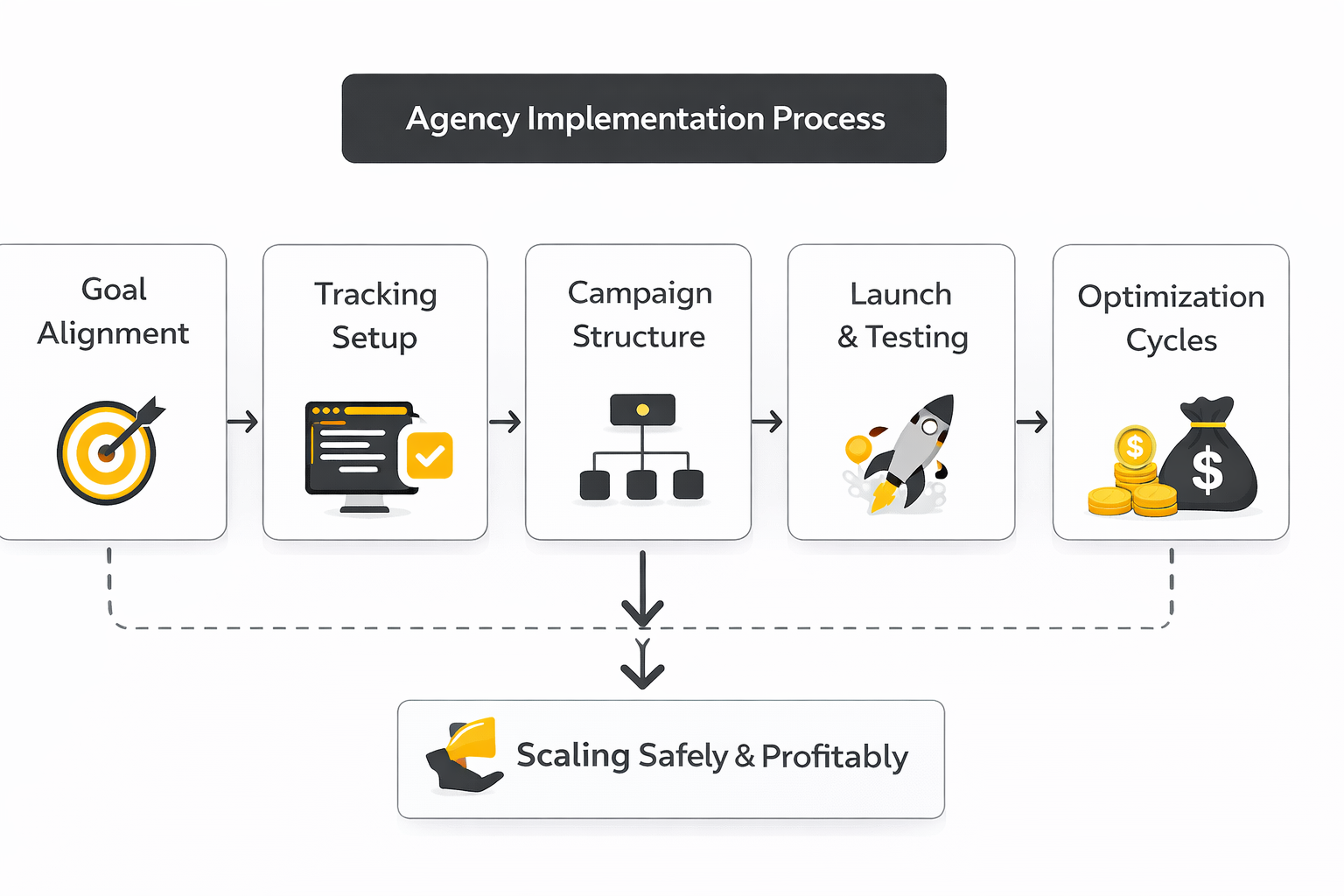
A credible process usually looks something like this:
- Business and offer alignment so the agency understands goals, margins, priorities, constraints, and what a qualified conversion actually means.
- Tracking and data validation so conversion actions, CRM handoffs, offline events, and duplicate handling are clean enough to trust.
- Account audit and segmentation plan so budgets, campaign types, keyword intent, geographies, and landing page paths reflect the real opportunity.
- Launch or restructure phase where the agency applies the new architecture, quality controls, and initial bid strategy.
- Signal collection period where early data is reviewed carefully instead of overreacted to.
- Optimization and testing cycles focused on the biggest performance levers, not cosmetic changes.
- Expansion decisions only after the team can see which offers, audiences, queries, or geographies deserve more budget.
That sequence is not about bureaucracy. It is about reducing the chance that the platform learns from weak inputs or that the client mistakes early noise for a stable pattern. The agencies that skip steps often create avoidable volatility, and then waste weeks trying to diagnose problems that should have been prevented during setup.
Pay Attention to Tool Choices, but Only in Context
Tools matter, but they should support the process rather than replace it. If an agency uses CRM, automation, landing page, or reporting software, the real question is whether those tools improve handoff speed, feedback quality, and decision-making. In lead-generation environments, that can include platforms like GoHighLevel for follow-up and pipeline visibility, or page-building tools like Replo when landing page iteration needs to move faster.
The important thing is not whether the agency names the right software stack. It is whether the stack reduces friction between click, conversion, qualification, and follow-up. A tool is useful when it shortens that path and makes better optimization possible.
The Best Agencies Make Their Process Easy to Inspect
This is the practical takeaway. The strongest agencies do not hide behind mystery, jargon, or overcomplicated dashboards. They make it easy for you to inspect how they think, how they measure, and how they execute.
That transparency is a signal in itself. A weak agency wants you to trust the performance story without seeing the operating system underneath it. A strong agency is comfortable letting you inspect the machine because it knows the machine is where the advantage actually lives.
Reading PPC Data Without Fooling Yourself
This is the section where a lot of agency evaluations go sideways. Buyers get shown a spreadsheet full of rising click-through rates, declining CPCs, and a few nice-looking conversion charts, then assume the account is healthy. But the best PPC agency is not the one with the prettiest dashboard. It is the one that knows which numbers matter, what they actually mean, and what action they should trigger next.
That sounds simple, but it is not. Modern paid media has more automation, more modeled data, and more attribution complexity than most teams are comfortable admitting. So the goal is not to collect more metrics. The goal is to build a measurement system that helps you separate signal from noise.
The First Rule: Efficiency Metrics Are Not Business Metrics
CTR, CPC, impression share, and cost per conversion all matter, but they are not the finish line. They are operating indicators that help you diagnose what is happening inside the account. If an agency treats them like the final proof of success, that is usually a sign the measurement system is too shallow.
Take click-through rate as an example. Fresh benchmark data shows average search CTR across industries still sits in a relatively healthy range, with LocaliQ’s 2025 benchmark update putting average search CTR at 3.17%, while broader benchmark coverage from the same publisher shows conversion rates and costs shifting materially by industry in 2025. That matters because a higher CTR can mean stronger message match, but it can also mean your ads are attracting curiosity instead of purchase intent. The action is not “celebrate higher CTR.” The action is “check whether the added clicks are improving qualified outcomes.”
The same goes for CPC. Lower CPCs can be a win if you are holding quality steady, but they can also come from drifting into weaker query intent or broader traffic that does not convert well. A good agency reads CPC changes in context, not in isolation. That is the difference between media management and actual commercial judgment.
Conversion Rate Only Matters When the Conversion Deserves to Exist
Conversion rate is one of the most abused metrics in PPC. People love it because it looks decisive, but it only tells the truth when the conversion being measured is tightly connected to business value. If the tracked event is a low-intent form fill, a duplicate lead, or an unqualified call, then a great-looking conversion rate can still represent weak performance.
That is why stronger agencies push hard on conversion definitions. Google has leaned heavily into enhanced conversions, offline conversion imports, and value-based bidding guidance for exactly this reason: the quality of optimization depends on the quality of the signal. If you feed the platform better conversion data, the platform can usually make better bidding decisions.
This should drive a very practical question when you are evaluating an agency: what exactly counts as a conversion in your reporting? If the answer is vague, generic, or obviously disconnected from revenue quality, the rest of the account analysis becomes much less trustworthy.
Benchmarks Help, but Only When You Use Them Properly
Benchmarks are useful as orientation, not as verdicts. They help you spot whether an account looks wildly out of line for its category, but they do not tell you whether the business is winning. Industry averages can hide massive differences in geography, funnel stage, deal size, brand strength, seasonality, and conversion definitions.
Recent benchmark reporting illustrates the point well. The latest Google Ads benchmark coverage from WordStream’s 2025 data set shows average search conversion rate at 7.52%, while the same family of benchmark reports highlights how widely CPL, CTR, and CPC move between verticals. That should not push you to chase the average. It should push you to ask whether your account economics make sense for your model.
A disciplined agency uses benchmarks to frame investigation. If your CPC is much higher than normal, it asks whether competition, targeting, or positioning is responsible. If your conversion rate is lower than benchmark, it checks landing page fit, offer strength, and lead friction before making bidding changes. That is how numbers become useful.
What the Data Should Actually Make You Do
The real value of analytics is not explanation after the fact. It is better decisions while the account is still movable. The best PPC agency uses reporting to decide where to push, where to pause, what to fix, and what to ignore.
That means every major metric should point toward an action. A CTR problem may point to ad relevance or weak intent alignment. A conversion-rate problem may point to landing page friction or a mismatch between keyword intent and offer. A rising CPA with stable close rates may still be acceptable if customer value supports it, while a stable CPA with collapsing close rates is a more serious warning sign.
Build the Measurement Stack in Layers
The cleanest way to interpret PPC performance is to read it in layers instead of staring at one blended dashboard. Start with delivery metrics, move to conversion metrics, then move to sales and revenue metrics. If you stop too early, you risk optimizing the wrong thing.
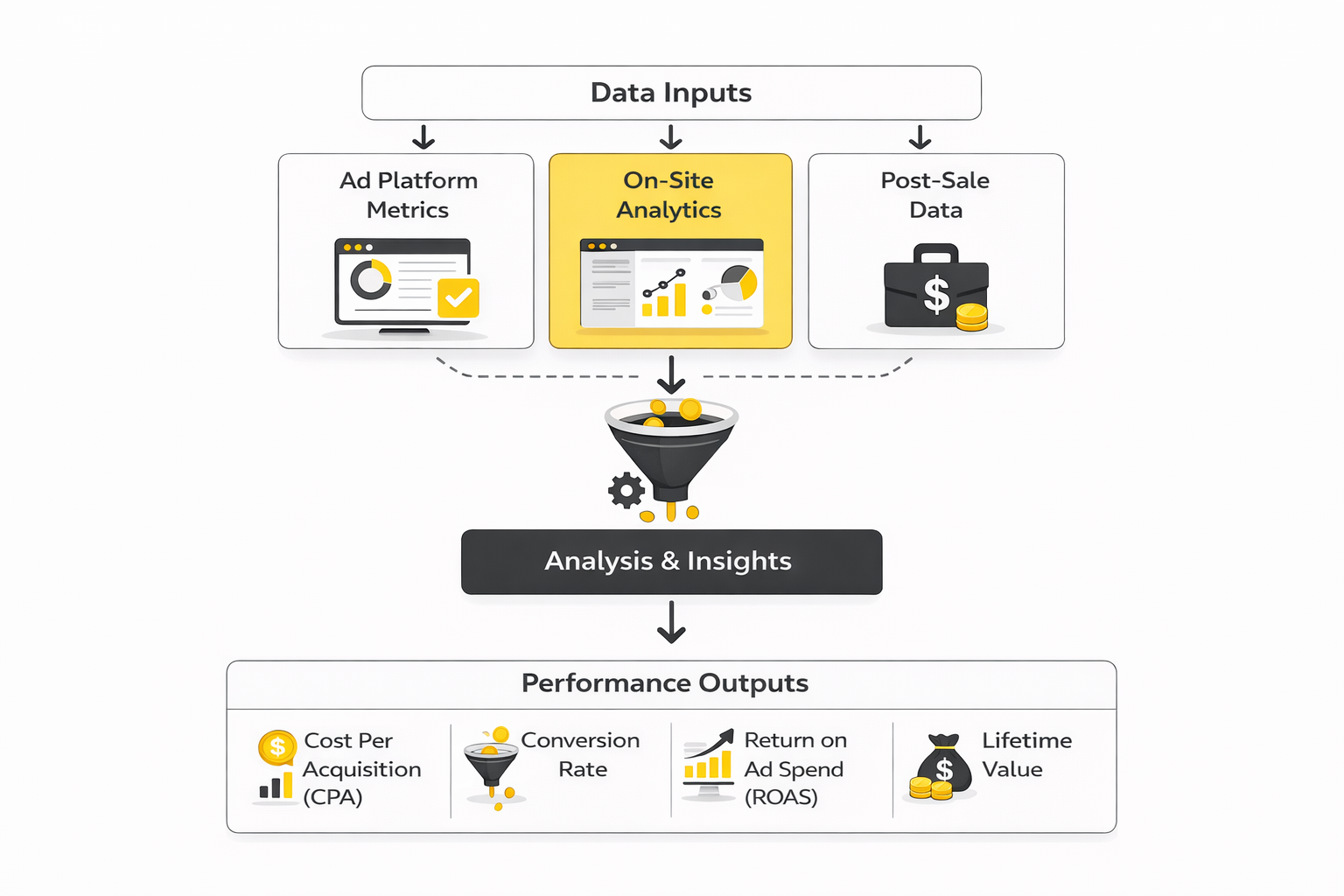
A practical stack usually looks like this:
- Traffic quality metrics such as CTR, CPC, search terms, impression share, and bounce behavior.
- Conversion mechanics such as landing page conversion rate, form completion rate, call connection rate, and cost per lead.
- Lead quality signals such as qualification rate, booked appointment rate, sales acceptance, or demo attendance.
- Revenue signals such as close rate, average deal size, payback period, and return on ad spend or contribution margin.
This layered view is exactly why data quality matters so much. Google’s own documentation on data-driven attribution and value-based bidding keeps returning to the same idea: better downstream data produces better upstream optimization. If your agency only reports on the first two layers, it may still be useful operationally, but it is not giving you the full picture.
Watch for Metric Combinations, Not Single-Number Stories
Single metrics are easy to manipulate. Metric combinations are much harder to fake. That is why strong agencies look for patterns across several numbers at the same time instead of building a narrative around one improvement.
For example, rising CTR plus flat conversion rate plus weaker qualification rate is not growth. It usually means the account is attracting more attention without attracting better buyers. Falling CPC plus rising close rate can be excellent if traffic quality holds. Rising CPA plus sharply better deal value can still be rational. The number is never the whole story by itself.
This is also where many agency reports become misleading. They show improvement in one visible metric and quietly skip the second-order effects that matter more. You want a partner that is comfortable saying a metric improved but the business impact did not, because that level of honesty is where good decisions start.
Market-Level Data Tells You Competition Is Not Getting Easier
A lot of teams still act like poor PPC performance must always come from bad management. Sometimes it does. But sometimes the market is simply getting more competitive, which makes good measurement even more important. The IAB/PwC full-year 2024 internet advertising report showed US digital ad revenue reaching $259 billion, up 15% year over year, with search continuing to hold a major share of spend.
That matters for agency evaluation because more money in the market usually means more competition for attention, more pressure on auctions, and less room for sloppy optimization. In other words, the bar keeps rising. When a PPC agency tells you results have become harder, that may be true. The relevant question is whether its measurement and optimization system is strong enough to deal with that reality better than the alternatives.
Holistic Measurement Is Still Rare, Which Creates an Edge
One of the most useful recent findings in marketing measurement is not really a media benchmark. It is an execution benchmark. Nielsen’s 2025 ROI Blueprint found that 85% of marketers feel confident they can track holistic performance, but only 32% actually measure holistically.
That gap matters because it means many teams still think they understand performance better than they really do. A strong PPC agency can create real advantage simply by connecting ad platform data, CRM outcomes, and business metrics more rigorously than competitors do. This is one of those areas where the edge is less glamorous than creative strategy, but often more valuable.
The Performance Signals That Deserve the Most Attention
When you strip the noise away, there are a few signals that tell you more than most of the dashboard combined. These are the ones I would pay attention to when judging whether an agency is actually helping.
Qualified Lead Rate
This is often more useful than raw conversion volume. If lead count rises but qualified lead rate falls, the platform may be finding cheaper conversions that the sales team does not actually want. That is not efficient growth. It is just lower filtering at the top of the funnel.
The action here is clear. Tighten conversion definitions, improve lead routing, and feed back better offline outcomes so the platform learns from the right users. If an agency is not obsessed with this feedback loop, it is leaving performance on the table.
Conversion Lag and Sales-Cycle Reality
Some campaigns look weak in a seven-day view and strong in a 30-day or 60-day view. Others look amazing early and then collapse once low-quality leads wash out. This is why time windows matter so much in reporting.
A serious agency should know how long your funnel takes to reveal the truth. It should not overreact to short-term variance if your sales cycle is long, and it should not hide behind long attribution windows if the account is clearly degrading. Interpretation matters as much as data collection here.
Cost Per Acquisition in Context
CPA is a useful control metric, but only in context. A “good” CPA depends on gross margin, close rate, customer lifetime value, fulfillment capacity, and cash flow tolerance. The best PPC agency will push you to define a target CPA range that reflects your economics, not just what looks neat in a report.
This is one reason Google keeps encouraging value-based bidding rather than pure volume optimization. Not all conversions are worth the same amount, and not all efficient-looking leads are equally valuable. Your agency should think the same way.
Search Query Quality
This one is less flashy, but it tells the truth fast. Search query quality shows whether your targeting and bidding system are attracting the right intent. If query quality declines, the rest of the metrics often get worse later.
That makes it a strong early warning system. Good agencies keep a close eye on what people actually typed before they clicked. They do not rely only on campaign-level performance summaries because those summaries can hide drift until it becomes expensive.
What Good Measurement Should Feel Like in Practice
Good measurement should make the account easier to understand over time, not harder. You should be able to see where money is working, where signal quality is weak, which tests are worth running, and what the next decision is. If reporting keeps getting more complex but clarity does not improve, something is wrong.
This is why the best PPC agency usually sounds calmer around data. It does not need to weaponize metrics or overwhelm you with charts. It uses numbers to sharpen judgment, not replace it.
That is the standard to keep in mind as the article moves toward the final decision stage. The agency you want is not the one with the biggest stack of statistics. It is the one that can translate performance data into smart, commercially grounded action before wasted spend turns into a bigger problem.