

Something went wrong. If this issue persists please contact us through our help center at help.openai.com.
Why Purchase Email Lists Usually Backfire
On paper, buying a database of prospects sounds like a shortcut. You skip the slow work of creating content, collecting signups, and nurturing interest, then jump straight to outreach. In reality, purchase email lists usually create three problems at the same time: weak consent, weak engagement, and weak deliverability.
The consent issue is the first crack in the strategy. Google explicitly tells senders not to purchase email addresses from other companies, and not to email people who did not sign up to hear from them. That matters because modern deliverability is no longer just about whether a message technically leaves your server. It is about whether mailbox providers trust your behavior enough to place your email in the inbox.
The engagement problem comes next. Even if the list vendor promises “verified” contacts, those people did not ask for your message from your brand. That makes opens lower, replies colder, spam complaints higher, and unsubscribes more likely. Once that pattern shows up, inbox providers treat your future mail more skeptically, including mail sent to legitimate subscribers you worked hard to earn.
Then comes the compounding effect. Google says bulk senders should keep spam complaints below 0.1% and prevent them from reaching 0.3%. Yahoo’s guidance also says to keep spam rates below 0.3%. When you start with a cold, third-party list, you are basically choosing the exact conditions that make those thresholds harder to hit.
The Legal Reality Is Much Stricter Than Most Buyers Expect
A lot of people assume the question is simply whether buying a list is “legal.” That framing is too simplistic, and honestly a little dangerous. The real question is whether you can prove the people on that list specifically agreed to receive marketing from your business, through the channel you plan to use, for the kind of message you want to send.
In the US, the FTC’s CAN-SPAM guide is often misunderstood as permission to blast cold lists as long as you include an unsubscribe link. That is not what smart operators should take from it. CAN-SPAM is a floor, not a growth strategy, and the FTC makes clear that the law applies to commercial messages broadly, including B2B email.
In the UK and much of Europe, the bar is often higher. The ICO says you must not send marketing emails to individuals without specific consent, except for narrow cases like your own existing customer relationships under the soft opt-in. It also says you should not use bought-in lists for email unless you have proof of opt-in consent within the last six months that specifically names your business.
That “specifically names your business” part is where many purchase email lists collapse. A list broker may claim the contact “agreed to receive offers from selected partners,” but that is not the same thing as consent to hear from you. The ICO’s marketing-list guidance goes further and says you must check that the list was collected fairly and that the consent is accurate, specific, and recent enough to cover your campaign.
Canada is even clearer about consent culture. The Government of Canada explains that CASL requires businesses to obtain consent before sending commercial electronic messages, and senders should be ready to prove it. That proof burden is exactly why list purchases look easy in a sales deck and messy in the real world.
Why Deliverability Gets Damaged So Fast
Deliverability used to be treated like a technical department problem. Now it is a business problem. You can write great copy, offer something useful, and still lose because mailbox providers are watching who wanted your message, how they reacted to it, and whether your sending patterns look trustworthy.
That matters more than ever because inbox placement is already under pressure. Validity’s 2025 benchmark report found that one in six legitimate marketing emails fails to reach the inbox, with global inbox placement around 83.5% in its underlying report data. In other words, even permission-based email is fighting for placement, so starting with purchased contacts is like running uphill with a backpack on.
Mailbox providers are also giving you less room for mistakes. Yahoo requires SPF, DKIM, DMARC alignment for bulk senders and a functioning one-click unsubscribe flow, while Google and Outlook have pushed the same overall ecosystem toward stronger authentication and cleaner list practices. Microsoft’s 2025 guidance tells high-volume senders to remove inactive or invalid addresses regularly because it lowers bounce rates and reduces spam complaints, which is the opposite of what usually happens with purchased databases.
The reputation systems are not subtle about this either. Outlook’s SNDS portal says deliverability to Outlook.com is based on your reputation, and that maintaining good reputation is the sender’s responsibility. Once your domain or IP starts looking noisy, recovery takes longer than most teams expect, and the cost is not only missed campaigns. It is lost trust across your whole email program.
The Hidden Cost of “Cheap” Leads
This is where the math gets ugly. A purchased list might look inexpensive compared with paid media, SEO, or partnerships, but the sticker price is not the real cost. The real cost is the damage done when a low-intent audience trains mailbox providers to distrust your domain.
You also pay operationally. Your team spends time validating addresses, segmenting weak data, writing outreach to people who do not know you, handling complaints, and troubleshooting why replies are dead. If the campaign performs badly, the usual reaction is to buy a bigger list or send more aggressively, which deepens the original problem.
Then there is platform risk. Email service providers are not neutral about this. Mailchimp says any list obtained from a third-party source violates its terms and puts you at risk. HubSpot’s acceptable-use framework is built around legal compliance and sender reputation, which is why marketers who rely on purchased contacts so often run into restrictions, warnings, or blocked campaigns.
A much better investment is building owned demand capture. A consent-based funnel using Brevo for forms and email capture, ManyChat for conversational lead collection, or GoHighLevel for landing pages, CRM, and follow-up may feel slower in week one. But it creates something far more valuable than a rented spreadsheet: a list of people who actually expect to hear from you.
What To Do If You Already Bought a List
A lot of teams are already here, and pretending otherwise is not helpful. Maybe the founder bought a file from a broker. Maybe sales imported contacts from a data vendor. Maybe a legacy agency left you with a giant CSV and no documentation. The wrong move now is to dump it into your main sending domain and hope volume will save you.
First, do not treat that list like a normal newsletter audience. If you cannot prove source, consent terms, collection date, and whether your brand was specifically named at capture, you should assume the data is risky. That does not mean every contact is useless, but it does mean your email marketing program should not be the place where you “test” it.
Second, separate CRM storage from marketing permission. Some teams keep third-party contacts in a database for research, account mapping, or sales intelligence while restricting who can be emailed through marketing automation. That distinction matters because a contact existing in your system is not the same as a contact granting permission for campaigns.
Third, protect your core domain reputation. Do not upload questionable records into the same environment you use for customer newsletters, product announcements, and lifecycle sequences. If your business depends on email, your sending reputation is infrastructure, not a disposable asset.
Finally, focus on conversion paths that create first-party permission from this point forward. Use lead magnets, webinars, calculators, demos, waitlists, and newsletter opt-ins. Tools like Fillout, Cal.com, and Buffer can help turn anonymous traffic and social attention into explicit, trackable consent instead of risky borrowed reach.
The Smarter Alternative: Build a List People Actually Want To Join
This is the shift that changes everything. Instead of asking how to buy attention, ask how to earn it. That single change improves compliance, performance, brand perception, and long-term economics at the same time.
The best email lists are built around a clear value exchange. Someone gives you access to their inbox because they expect something specific in return: insights, tools, savings, updates, templates, invitations, or education. When that expectation is clear, engagement rises naturally, and engagement is one of the strongest signals you can send to mailbox providers.
That is why permission-based growth compounds while purchase email lists decay. A good opt-in system gets stronger as you learn what attracts the right people, which forms convert, which messages get replies, and which segments actually buy. A bought list does the opposite. It gets older, noisier, and more expensive to salvage with every send.
If you are serious about building a channel that lasts, invest in acquisition assets you control. Create better landing pages, stronger lead capture, better follow-up, and cleaner segmentation. That approach is less flashy than buying a file full of contacts, but it is how you build an email list that becomes an asset instead of a liability.
How To Replace Purchased Contacts With a Permission-Based System
If you want predictable growth, the fix is not to get better at purchase email lists. The fix is to build a system that turns attention into consent, then turns consent into revenue. That sounds slower at first, but it gives you something a broker never can: a list you can keep using without constantly fighting compliance problems, weak response rates, and deliverability drag.
The good news is that this is not complicated once you stop overthinking it. You need one clear reason to subscribe, one simple path to opt in, one welcome sequence, and one measurement loop. That is enough to replace the false shortcut of bought data with a list-building engine that actually improves over time.
The Simple Funnel That Works
Most companies do not need a giant funnel map with twenty automations on day one. They need a clean flow from traffic to signup to first conversion. A practical baseline is a landing page, a form, a confirmation step, a welcome email, and a short nurture sequence that helps the subscriber take the next obvious action.
That baseline already puts you ahead of the purchased-list mindset. Instead of interrupting strangers, you are creating a value exchange and letting interested people raise their hands. That one change affects everything downstream, from list quality to engagement to inbox placement.
A useful reality check here is that even strong landing pages are not magic. Unbounce’s 2024 benchmark data put the median landing page conversion rate at 6.6% across industries, which is a solid reminder that list growth usually comes from steady optimization, not one lucky campaign. Once people are on the list, permission-based email has much healthier benchmarks to work with, with Mailchimp reporting 35.63% average opens, 2.62% click rates, and 0.22% unsubscribes across all users.
Build The Offer Before You Build The Form
This is where most weak email programs go wrong. They launch a popup or footer form that says “Join our newsletter,” then wonder why nobody cares. People do not subscribe because you want leads. They subscribe because the offer feels useful, timely, or exclusive.
The best replacement for purchase email lists is not “more traffic.” It is a sharper signup reason. That could be a pricing calculator, a teardown, a weekly tactic email, a template pack, a waitlist, a private webinar, an onboarding checklist, or a product-specific discount if you are in ecommerce. The format matters less than the clarity of the promise.
Before you touch software, write these three things in plain English:
- What exactly is the person getting?
- How quickly do they get it?
- Why is it worth giving you inbox access?
If you cannot answer those in one breath, your form will underperform no matter how pretty the page looks.
Set Up The Capture Layer The Right Way
Once the offer is clear, build the capture points. This is where your implementation becomes real, because now the subscriber journey is visible and measurable. Use one main landing page, one embedded form on high-intent pages, and one lighter signup prompt for blog or social traffic rather than spraying forms everywhere.
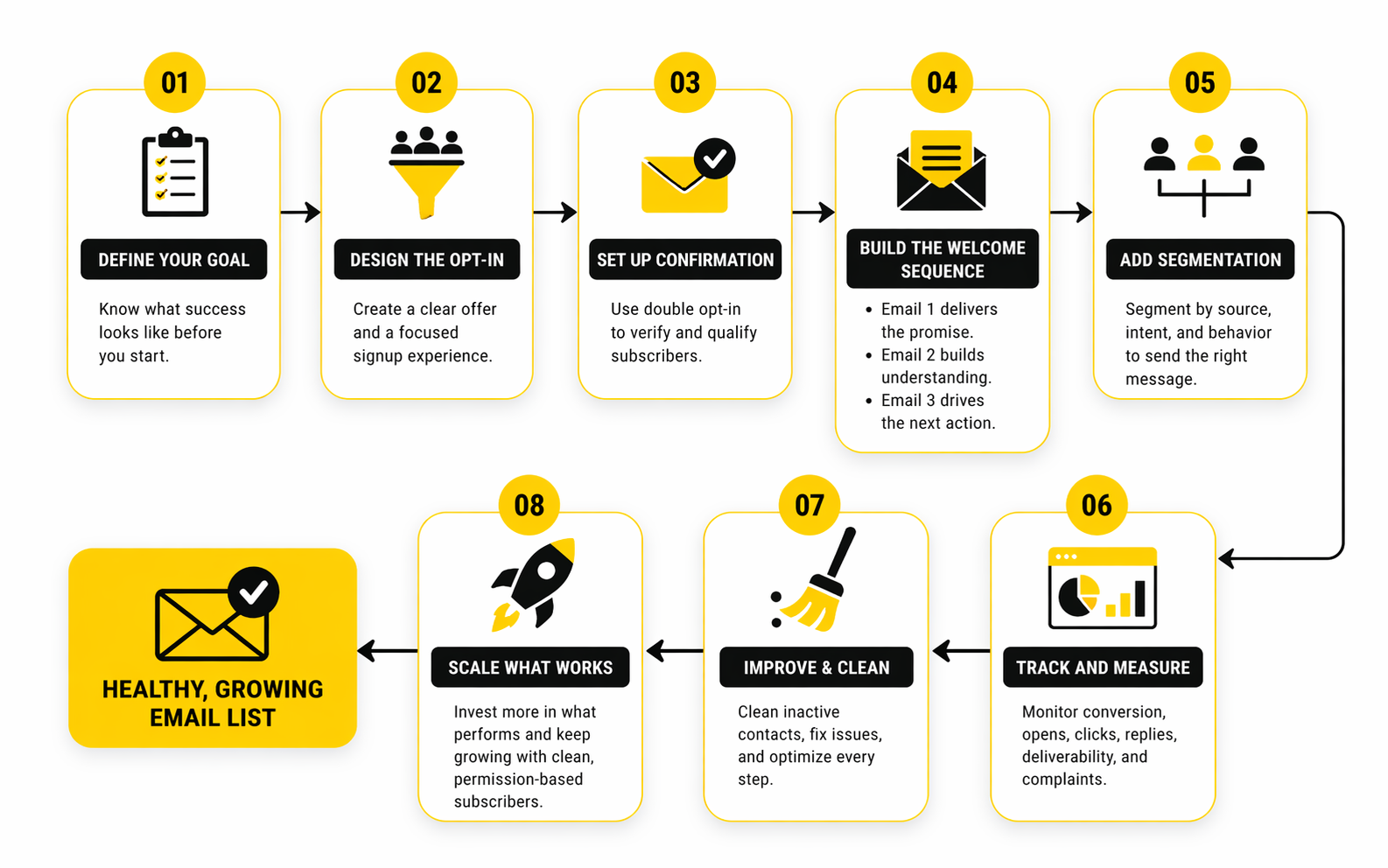
A clean setup usually looks like this:
- A traffic source brings the visitor in.
- The page makes one focused promise.
- The form asks for the minimum information needed.
- The subscriber confirms intent.
- The welcome sequence delivers the promised value fast.
- The next emails move them toward a demo, reply, purchase, or booked call.
This is also the moment to avoid the biggest technical mistake people make after abandoning purchase email lists: collecting addresses without protecting list quality. Google’s sender guidance says bulk senders should use SPF, DKIM, and DMARC, and both Google and Yahoo expect working one-click unsubscribe and cleaner mailing practices for high-volume senders here and here. On the list-building side, Brevo explains that double opt-in helps validate contact information and improve deliverability, which is exactly why it is a smart default when quality matters more than vanity growth.
If you want a fast stack, Replo is useful for conversion-focused pages, Fillout makes clean forms easy, and Brevo gives you the email infrastructure to manage confirmations, segmentation, and campaigns without bolting five tools together on day one.
Write The Welcome Sequence Before You Drive More Traffic
A lot of teams obsess over list growth and ignore what happens right after the signup. That is a mistake, because the first message shapes expectations and teaches subscribers whether opening your emails is worth it. If that first experience is vague, slow, or generic, the rest of the sequence has to work much harder.
Your first three emails should do distinct jobs. The first delivers the promised asset or benefit immediately. The second explains the problem your product or service solves in practical terms. The third creates a clear next step, such as replying to a question, booking a call, starting a trial, or reading a deeper guide.
This does not need to be fancy. Brevo’s welcome-email guidance stresses starting the relationship right away, and Klaviyo’s 2025 benchmark summary notes that welcome emails average 51% opens, with top-performing welcome emails reaching 15% click rates. The point is not to chase those exact numbers. The point is that people who just opted in are far warmer than names pulled from purchase email lists, so your system should capitalize on that window immediately.
For service businesses, a smart sequence often ends with a booking prompt through Cal.com. For creators and educators, it can move into community, content, or webinar invitations. For ecommerce, it usually hands off into product education, social proof, and offer timing.
Add Segmentation Early, But Keep It Simple
You do not need advanced lifecycle architecture in week one. You do need a way to stop sending the same email to everybody. The easiest segmentation model is based on source, intent, and action.
Source tells you where the person came from, which helps you align future messaging with the promise that brought them in. Intent tells you what they asked for, such as a template, demo, guide, or offer. Action tells you what they did next, which is far more useful than broad demographic assumptions.
That gives you enough structure to personalize without creating chaos. Someone who signed up for a checklist should not get the same immediate sequence as someone who requested pricing. Someone who clicked product education twice is different from someone who never opened the second email. This is where platforms like GoHighLevel or Copper can help if you want CRM visibility without losing the thread between lead capture and follow-up.
Track The Right Numbers So You Do Not Drift Back To Bad Habits
The whole reason people buy lists is impatience. They want fast volume because it feels measurable. So when you replace purchase email lists with a permission funnel, you need a scoreboard that proves the new approach is working.
Watch five things every week:
- Landing page conversion rate
- Confirmation rate if you use double opt-in
- Welcome email open rate
- Welcome email click or reply rate
- The percentage of subscribers who reach your next meaningful action
Those metrics tell you where the system is breaking. If traffic is high and opt-ins are low, the page or offer is weak. If opt-ins are high and confirmations are low, the form promise or confirmation email needs work. If confirmations are high and clicks are dead, your welcome sequence is not connecting.
This is the practical difference between real list building and bought data. A permission-based system gives you levers you can improve. A purchased list mostly gives you noise.
A 30-Day Rollout You Can Actually Execute
In the first week, define the offer, write the page, set up the form, configure authentication, and publish the signup flow. In the second week, write the three-email welcome sequence and connect one clear conversion goal, whether that is a sale, a reply, a booked call, or a trial. In the third week, add one or two new capture points from channels you already own, such as blog traffic, social traffic, or existing customer touchpoints.
In the fourth week, review the numbers honestly and tighten the weak spots. Improve the headline if the page is not converting. Shorten the form if unnecessary friction is blocking signups. Rewrite the second email if people open but do not click.
That is the implementation process most businesses actually need. Not another spreadsheet of strangers. Not another experiment with purchase email lists. Just a clean, consent-based system that gets a little better every week.
The Numbers That Tell You Whether Your Email Strategy Is Healthy
Once you stop relying on purchase email lists, measurement gets a lot more useful. You are no longer staring at vanity volume and pretending it means traction. You are looking at signals that tell you whether people wanted the message, whether inbox providers trusted it, and whether the system is creating real business outcomes.
That shift matters because bad email programs often look busy before they look broken. You can send thousands of emails and still miss the core issue if the wrong people are receiving them, ignoring them, or marking them as spam. The right analytics stack helps you catch that early.
Start With Deliverability, Not Opens
Most teams still look at open rates first because they are easy to spot. The problem is that opens are not the clearest early warning sign anymore, especially after privacy changes and image preloading behavior. Deliverability tells you more about the structural health of your program.
That is why inbox placement should sit near the top of your dashboard. Validity’s 2025 deliverability benchmark shows average global inbox placement at 83.5%, with 6.7% going to spam and 9.8% missing entirely, which means roughly one in six legitimate marketing emails still fails to reach the inbox. If your email strategy is built on purchase email lists, you are starting from a weaker trust position inside an environment that is already tough for permission-based senders.
The action this should drive is simple. If inbox placement is soft, do not “fix” it by sending more. Fix the underlying trust signals first: list source, complaint rate, authentication, segmentation, and inactive-contact cleanup.
Complaint Rate Is The Metric You Cannot Ignore
If there is one number that exposes the weakness of purchase email lists fast, it is complaint rate. A person who never asked for your email may ignore it, unsubscribe, or report it as spam. That last action carries outsized weight because it tells the mailbox provider your message was unwanted.
Google says bulk senders should prevent spam rates from reaching 0.3%, and its public guidance in the Gmail ecosystem also reinforces that healthy programs should stay well below that threshold. Yahoo says bulk senders should remain below a 0.3% complaint rate. In practical terms, that means three complaints out of every 1,000 emails can already put you in dangerous territory.
That number matters because complaint rate is not just a campaign result. It is a trust score. If your complaints rise, the correct move is usually to narrow segments, reduce frequency, pause cold or questionable sources, and remove anyone who is not engaging, not to “push through” with more sends.
Bounce Rate Tells You Whether Your Data Is Rotten
Bounce rate is one of the fastest ways to tell whether your acquisition quality is real or fake. When you buy data, even “verified” records often include outdated addresses, abandoned inboxes, role accounts, recycled domains, or contacts that were never fit for campaign use in the first place. That drives rejection at the server level before the recipient even has a chance to ignore you.
Brevo’s 2025 benchmark summary reports an average bounce rate of 0.51% across its dataset, while ActiveCampaign’s benchmark guide says less than 2% is a good average bounce rate and below 1% is ideal. Those are useful reference points because they remind you that healthy permission-based programs usually operate with relatively low bounce levels. Once you move well past that, the message is not “send harder.” The message is “your data quality is deteriorating.”
The action here is operational. High bounce rates should trigger list hygiene, source review, suppression of old segments, and a hard stop on questionable imports. If the addresses came from purchase email lists, the bounce rate is not a nuisance metric. It is your system telling you the foundation is bad.
Engagement Benchmarks Only Matter In Context
This is where marketers often confuse average performance with good performance. A benchmark is useful as a directional check, not as a trophy. It helps you understand whether you are in a normal range, but it does not tell you whether your list quality, message-market fit, or business model is actually strong.
Mailchimp’s current benchmark page puts average email open rates around 34.23% overall, with industry variation, while Brevo’s 2025 benchmark data shows a 21% open rate, 3.96% click-through rate, 0.15% unsubscribe rate, and 0.51% bounce rate in its own dataset. Those numbers are not contradictory so much as they are a reminder that platform populations, calculation methods, geographies, and list quality all shape the benchmark you are reading. That is exactly why random stat dumping is useless.
What matters is trend plus context. If your open rate drops while complaints rise, that is different from an open-rate dip caused by a subject-line test. If clicks stay flat but revenue per email improves, that may mean you are attracting fewer but better-fit subscribers. The right response depends on the whole pattern, not one isolated number.
Measure The Funnel, Not Just The Email
A healthy email program begins before the first send. That means your analytics should connect traffic, signup, confirmation, welcome sequence, and downstream action. Otherwise you risk blaming email for a problem that started with weak targeting or a poor signup promise.
The simplest useful funnel view looks like this:
- Visitor-to-signup rate
- Signup-to-confirmation rate if you use double opt-in
- Welcome email open rate
- Welcome email click or reply rate
- Next-step conversion rate such as trial, demo, booking, or purchase
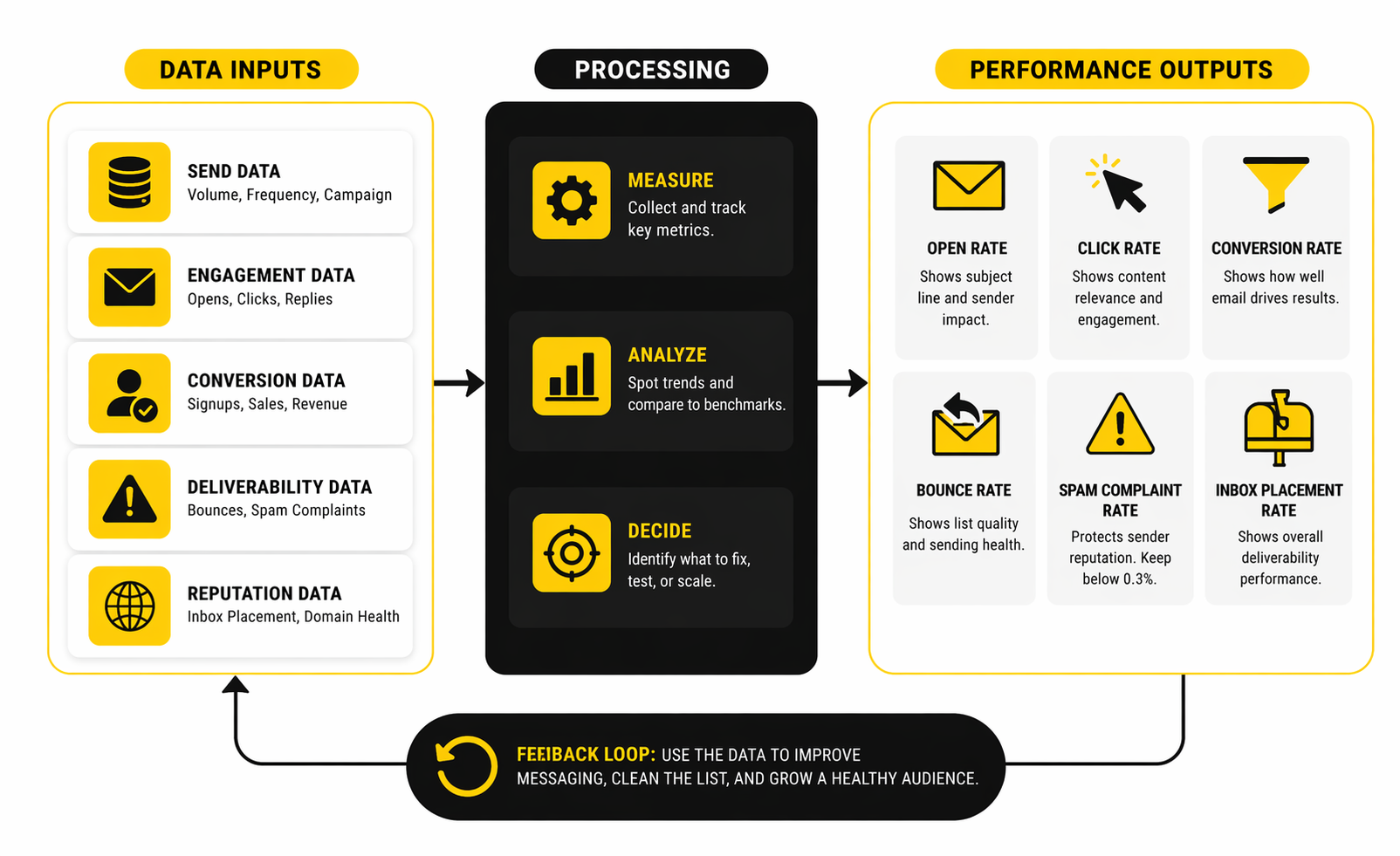
This is where the weakness of purchase email lists becomes obvious. A bought list skips the visitor, signup, and confirmation stages entirely, which means you lose the data that explains intent. You may still get delivery numbers, but you do not get a real funnel. You get output without context.
That is why owned-list analytics are more valuable. They show where trust is being built and where friction is being created. When you can see the full path, you can improve the actual system instead of guessing from campaign snapshots.
Welcome Email Data Usually Reveals The Truth Fast
The welcome sequence is one of the cleanest measurement windows you have because it hits people right after they opted in. Their intent is fresh, the promise is still top of mind, and the gap between expectation and delivery becomes obvious very quickly. If this sequence underperforms, the issue is usually not the algorithm. It is the offer, the message, or the handoff.
Klaviyo’s welcome email benchmarks show average welcome-email open rates around 51%, with top-performing welcome emails reaching 15% click rates. That matters because it gives you a strong comparison point for real permission-based momentum. When someone joins intentionally, first-touch engagement should feel noticeably stronger than ordinary broadcast traffic.
The action this drives is clear. If your welcome email is weak, improve the promise match, shorten the delay, deliver the asset faster, and make the next action more obvious. Do not distract yourself by buying more traffic or experimenting with purchase email lists while the first conversion step is still leaking.
Use Google Postmaster And Sender Diagnostics Like A Control Panel
Once your volume is large enough, sender diagnostics stop being optional. Google’s Postmaster Tools exist for a reason: they give qualified high-volume senders visibility into spam reports, delivery errors, and domain reputation signals. That is the kind of information you need when inboxing problems are subtle and campaign reports alone are not enough.
This matters because campaign dashboards can make everything look normal while your reputation quietly weakens underneath. You might still see sends, opens, and some clicks, but the domain can already be drifting into a higher-risk zone with Gmail or Outlook. Looking at complaint trends, domain reputation, and authentication status gives you a more honest picture of what is happening.
The action here is ongoing monitoring, not panic. Check sender diagnostics regularly, especially after list imports, major volume changes, or aggressive promotional pushes. If you see deterioration, treat it like infrastructure maintenance, because that is what it is.
What Good Data Should Make You Do Next
The point of analytics is not to create prettier reporting slides. The point is to make better decisions faster. Good email data should tell you whether to clean the list, rewrite the offer, tighten segmentation, slow sending cadence, improve authentication, or invest more heavily in what is already working.
That is why purchase email lists are such a weak long-term play. They flood your dashboard with numbers, but many of those numbers are symptoms, not assets. You spend time explaining away complaints, bounces, and weak engagement instead of building a system that gets stronger with every honest opt-in.
A useful rule is this: when the data points to trust problems, solve trust problems. Do not hide them behind bigger sends, clever copy, or another vendor promise. The brands that win with email are usually not the ones sending the most. They are the ones measuring the right things, interpreting them honestly, and acting before small issues turn into reputation damage.
What Changes When You Start Scaling
At small volume, weak email practices can hide for a while. A few sends go out, a few clicks come back, and nobody feels the damage yet. Once volume grows, though, purchase email lists stop looking like a shortcut and start acting like a liability because mailbox providers, complaint systems, and platform rules all become less forgiving at scale.
That is the strategic shift most teams miss. The question is no longer whether you can get more addresses into a platform. The question is whether your acquisition model can keep producing consent, engagement, and trust while your send volume increases. If the answer is no, scaling just amplifies weak inputs.
This is why experienced operators treat list quality like infrastructure. A broken landing page costs you conversions. A broken sender reputation costs you access to the inbox. One problem hurts growth. The other can stall the whole channel.
First-Party And Zero-Party Data Become More Valuable Than Raw Volume
As your program matures, the best asset is not a bigger contact count. It is better information about intent. First-party data gives you behavioral signals from your own properties, while zero-party data gives you explicit preferences that people intentionally share, which is exactly the kind of transparency that makes personalization stronger without feeling invasive.
That matters because scale creates message fatigue fast when you do not know enough about the person receiving the email. If someone joined because they wanted pricing guidance, they should not get the same flow as someone who wanted templates or educational content. Purchase email lists flatten all of that nuance into a name and an address, which is why they get weaker as complexity rises.
This is also where smarter collection systems pay off. A conversational opt-in flow through ManyChat can capture intent before the email even starts. A qualification layer through Chatbase can sort serious prospects from casual visitors. The result is not just a cleaner list. It is a list that tells you how to communicate.
Governance Matters More Than People Expect
Most email problems are not creative problems. They are governance problems. Teams import contacts without documenting source, sales and marketing define permission differently, legacy segments stay active too long, and nobody owns the rules for suppression, re-engagement, or sunsetting.
That gets risky fast when multiple people touch the same database. If there is no shared standard for what counts as marketable consent, questionable records slip into campaigns and your reporting starts mixing high-intent subscribers with cold or stale contacts. That makes interpretation harder and bad decisions easier.
Good governance is boring, but it is one of the clearest dividing lines between brands that scale cleanly and brands that keep flirting with purchase email lists when results soften. Document where each subscriber came from, what they signed up for, when they engaged last, and what should automatically suppress them. Once that is in place, the channel becomes much easier to trust.
List Hygiene Is Not Maintenance, It Is Strategy
A surprising number of teams still treat list cleaning like occasional housekeeping. At scale, that mindset does real damage. Microsoft’s 2025 requirements for high-volume senders explicitly push authentication, list hygiene, and bounce management because poor hygiene affects both sender reputation and the broader email ecosystem.
The practical implication is simple. Not every subscriber should stay on your active list forever just because they once opted in. Inactive contacts drag down engagement, increase the chance of complaints, and make it harder to tell whether your current messaging is actually working. That is one reason mature programs regularly suppress or segment non-engagers instead of endlessly emailing the full database.
This is where inexperienced teams drift back toward shortcuts. They see active audience size shrink after cleanup and panic. Then they look at purchase email lists again because the raw volume feels comforting. But inflated reach with weak intent is not growth. It is just a prettier version of decay.
Paid Acquisition Can Strengthen Your List Or Hide A Broken Offer
Paid traffic is not the enemy here. In many cases it is exactly how you accelerate list growth responsibly. The problem starts when paid acquisition is used to force signups into a weak funnel instead of validating that the value exchange is strong enough to earn permission.
That tradeoff matters more as budgets rise. If your landing page, offer, and welcome flow are healthy, paid traffic can become a reliable engine for first-party list growth. If those pieces are weak, paid traffic only buys you more top-of-funnel noise and a false sense that scale is working.
The smarter move is to use paid channels to test offer quality, not to disguise it. Build pages that convert, shorten time to value, and feed high-intent subscribers into segmented flows. Tools like Replo, Systeme.io, or ClickFunnels can help if the goal is building clean opt-in infrastructure rather than chasing a rented audience.
Multi-Channel Capture Beats Single-Channel Dependence
Another advanced consideration is channel concentration. If all list growth depends on one channel, the whole system becomes fragile. A change in ad costs, search visibility, social reach, or partnership volume can slow acquisition overnight.
That is why the strongest email programs usually collect permission from several touchpoints. Social content can feed newsletter signups. Webinars can feed demos. Referral loops can feed educational sequences. Owned media can keep adding qualified subscribers even when paid performance fluctuates.
This is also where purchase email lists look especially weak in comparison. They do not create a growth engine. They create a one-time injection of questionable reach. A better long-term system uses multiple capture surfaces and then routes subscribers into the right journey based on source and intent. Buffer, Flick, and Dub can support the front end of that by helping turn distribution into owned traffic instead of rented attention.
Reputation Monitoring Has To Become Routine
When your program grows, diagnostics cannot stay optional. Google’s Postmaster setup guidance says its dashboards provide data on spam rate, reputation, authentication, and delivery errors for personal Gmail traffic, and Google’s sender FAQ makes clear that spam-rate thresholds directly affect whether bulk senders remain eligible for mitigation.
That changes how advanced teams operate. They do not wait until campaigns visibly collapse before checking sender health. They watch for trend deterioration, especially after imports, promotional bursts, or big segmentation changes. Reputation monitoring becomes part of weekly operations, not an emergency response.
This is one more reason purchase email lists become more dangerous as the business grows. At low sophistication, the damage may feel abstract. At higher sophistication, it becomes visible in the exact systems you rely on to protect the channel.
The Real Strategic Tradeoff
At the expert level, this entire topic comes down to one tradeoff: do you want rented reach or compounding reach. Purchased contacts can create the illusion of momentum because they increase list size instantly. But they do not improve trust, they do not deepen intent, and they do not make future campaigns easier to send.
Compounding reach works differently. Every honest signup improves your understanding of what attracts the right audience. Every clean segment gives you sharper messaging. Every well-run welcome flow makes the next campaign stronger. Over time, the system gets more efficient because the data is yours, the permission is yours, and the relationship is real.
That is why strong operators eventually stop asking whether purchase email lists can work. The more useful question is whether they help build an asset worth protecting. Once you look at it that way, the answer gets a lot clearer.
Final Takeaways And The Healthiest Long-Term Setup
By this point, the pattern should be clear. Purchase email lists usually fail for the same reason they look attractive in the first place: they promise speed without trust. That trade almost always gets worse as soon as you factor in complaint thresholds, inbox placement pressure, stale data, and the fact that modern mailbox providers want to see real permission signals, not just technical sending capability. Google’s bulk sender guidance and Yahoo’s sender best practices are both moving in the same direction, which tells you this is not a temporary platform mood swing. It is the operating environment now.
The healthier system is simpler than people think. You attract attention through content, offers, partnerships, paid traffic, or social distribution. You convert that attention into explicit opt-ins. Then you segment, welcome, nurture, and measure the relationship like an asset instead of treating the inbox like rented ad inventory.
That is the ecosystem worth building because it compounds. A better offer improves signup rate. Better onboarding improves engagement. Better engagement improves deliverability. Better deliverability improves revenue per send. And once that loop is working, you stop being tempted by purchase email lists because you finally have something more valuable than a database: a system.
If you want to tighten that ecosystem even further, the most useful tools are the ones that help you create permission cleanly and manage it without friction. Brevo can handle capture, campaigns, and automation, ManyChat can turn conversations into qualified subscribers, and GoHighLevel can connect pages, CRM, and follow-up into one operating layer. The exact stack is less important than the principle: build around consent, not borrowed reach.
FAQ
Is it ever legal to buy email lists?
Sometimes people ask this as if legality is the only filter that matters. It is not. In many jurisdictions the real question is whether you can prove the recipient specifically consented to receive marketing from your business, not just from “partners” in general, which is why guidance from the ICO on bought-in lists and Canada’s CASL consent rules makes this much stricter than most marketers expect.
Even where some outreach may appear technically permissible, purchase email lists still create major deliverability and platform-risk problems. That means “can I” is usually the wrong question. The better one is whether the list can be used without damaging sender trust, and in most cases the answer is no.
Why do vendors say their lists are verified?
Because “verified” sounds safer than it usually is. In practice, it often means the vendor checked whether an address exists or whether an inbox might still accept mail. That is not the same thing as proving consent, interest, relevance, or recent engagement.
This distinction matters a lot. A valid address can still be a terrible marketing contact if the person never asked to hear from you. That is why purchase email lists can contain technically deliverable records that still perform badly and produce complaints.
Can purchase email lists work for B2B?
B2B does not magically erase trust problems. Even when business email addresses are publicly available, that does not automatically make them fair game for ongoing marketing campaigns. The bigger the list and the more promotional the message, the more likely you are to run into reputation, complaint, or platform problems.
B2B teams usually get better outcomes when they separate account research from permission-based email marketing. Use data tools for targeting and sales intelligence if needed, but build actual email programs around people who subscribed, requested a demo, downloaded something relevant, or otherwise showed intent.
What is the biggest deliverability risk with bought lists?
Complaint rate is usually the fastest and most dangerous signal. Google says bulk senders become ineligible for mitigation when user-reported spam rates exceed 0.3%, and Yahoo uses the same 0.3% spam-rate standard. That is a very small margin for error.
The reason this gets ugly fast is simple. People on purchase email lists did not ask for your message from your brand. That makes them more likely to ignore it, unsubscribe, or mark it as spam, and once those patterns show up, mailbox providers do not isolate the damage to that one campaign.
Are purchased lists worse than scraped lists?
Yes, but not by enough to make purchased lists smart. Scraped lists are usually an obvious mess because the contacts never consented and the data collection method itself is weak. Purchased lists are often packaged more professionally, which can make them feel safer than they are.
That is the trap. The nicer the spreadsheet looks, the easier it is to confuse packaging with quality. From a reputation and permission standpoint, both approaches create risk because neither starts with a direct relationship between the subscriber and your brand.
What should I do if my company already uploaded a bought list into our ESP?
Do not keep treating it like a normal subscriber segment. First identify the source, collection method, consent language, capture date, and whether your brand was specifically named at opt-in. If you cannot verify those details, you should assume the list is risky and keep it away from your core marketing program.
The next move is to protect the main sending environment. Keep your legitimate subscribers segmented, pause questionable sends, and focus on rebuilding first-party acquisition. It is much easier to stop damage early than to repair a weakened domain reputation later.
Is double opt-in worth the friction?
For many businesses, yes. It can reduce fake submissions, typos, and low-intent signups, which helps keep your list cleaner and your engagement stronger. That is especially useful if your acquisition relies on content distribution, giveaways, broad social reach, or lead magnets that may attract casual curiosity.
The key is not to treat double opt-in as dogma. Treat it as a quality-control lever. If list quality is more important than raw signup volume, it is usually a smart move.
What metrics matter more than open rate?
Open rate still has directional value, but it should not lead the dashboard by itself. Inbox placement, complaint rate, bounce rate, confirmation rate, welcome-sequence clicks, replies, and downstream conversion tell you much more about whether the system is healthy.
This matters because purchase email lists can generate misleading activity without showing real momentum. A few opens do not offset weak trust. The best measurement setup tells you whether the subscriber journey is producing consent, engagement, and meaningful action, not just whether the pixels fired.
How fast can I grow a list without buying one?
Faster than most people think if the offer is sharp and the traffic is relevant. A useful lead magnet, webinar, calculator, template pack, or strong newsletter angle can create steady acquisition if the landing page is clear and the welcome sequence is strong. Unbounce’s landing page benchmark data is a good reminder that conversion is usually the result of offer quality and optimization, not magic.
That said, real list growth is usually lumpy at first. The point is not to make the graph look exciting in week one. The point is to build a system that keeps converting without poisoning your deliverability every time you want more volume.
Should I rent a list instead of buying one?
Not usually. Renting may change the mechanics, but it does not solve the core issue if the recipients still do not expect to hear from your brand. You may avoid some direct handling of the data, but you are still depending on someone else’s relationship and someone else’s definition of permission.
That means the strategic downside remains. You still do not own the audience, you still do not control the trust foundation, and you still are not building a compounding first-party asset.
What is the safest alternative to purchase email lists for a new business?
Build one focused offer and one clean subscriber path. Start with a landing page, a simple form, a welcome sequence, and a clear next step such as a demo, consultation, free trial, or educational series. Then drive traffic from the channels you already control, like organic content, partners, community, social, or paid search.
New businesses often think they need a giant tech stack to do this well. They do not. They need clarity, consistency, and a fast handoff from signup to value.
Can cold outreach replace list building?
Cold outreach and list building are not the same discipline. Cold outreach is usually one-to-one or tightly targeted one-to-few communication, often handled by sales teams with careful relevance and smaller volume. Email list building is about ongoing permission-based marketing at scale.
Problems start when companies blur those lines. They buy broad contact databases, treat them like subscribers, and then wonder why performance collapses. If you are doing outbound, keep it tightly targeted and operationally separate from your permission-based email marketing.
What does a healthy email ecosystem look like in practice?
It starts with owned traffic sources and a clear value exchange. It includes explicit signup capture, proper authentication, clean onboarding, basic segmentation, regular list hygiene, and reputation monitoring. It also assumes that not every contact belongs in every campaign forever.
That kind of system is slower to build than purchase email lists, but much easier to scale. Each honest opt-in gives you more signal, more trust, and better future performance. That is what makes it durable.
Work With Professionals
Explore 10K+ Remote Marketing Contracts on MarkeWork.com
Most marketers spend too much time chasing clients, competing on crowded platforms, and losing a percentage of every project to middlemen.
MarkeWork gives you a better way. Browse thousands of remote marketing contracts and connect directly with companies desperate to hire skilled marketers like you, without platform commissions and without unnecessary gatekeepers.
If you're serious about finding better opportunities and keeping 100% of what you earn, explore available contracts and create a profile for free at MarkeWork.com.